
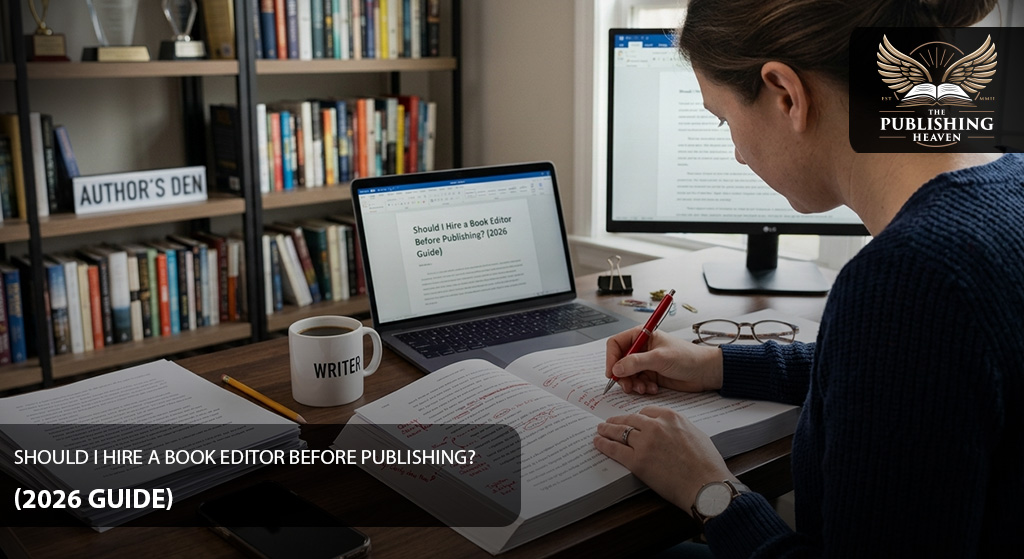
You’ve spent months, maybe years, writing your book. You’ve poured your heart into every chapter, revised until your eyes blurred, and finally typed “The End.” Now you’re staring at your manuscript and asking yourself a terrifying question: Should I hire a book editor before publishing?
This is one of the most critical decisions you’ll make as an author. And the truth is, most writers get it wrong.
Here’s the problem: you’re too close to your work. You know what you meant to say, so your brain automatically fills in gaps, overlooks repetition, and misses confusing passages. What reads perfectly to you may leave your readers scratching their heads. Worse, typos, inconsistent details, and weak prose can destroy your credibility before readers even get past the first chapter.
Why this matters more than you think: In today’s crowded publishing landscape, readers have endless choices. They won’t give your book a second chance if the first few pages feel unpolished. Literary agents and publishers receive thousands of submissions daily, and an unedited manuscript is an instant rejection. If you’re self-publishing on platforms like Amazon KDP, your book competes directly with traditionally published works that have undergone professional editing. Skipping this step isn’t just risky; it’s professionally irresponsible.
In this article, you’ll learn:
- Exactly why every author, including bestsellers, needs an editor
- The five types of book editing and which one your manuscript needs right now
- A practical checklist of what a good editor actually fixes
- Step-by-step guidance on when to hire an editor (and when to wait)
- Realistic costs so you can budget confidently
- How to choose the right editor who respects your voice and elevates your work
- What happens if you skip editing altogether
By the end of this guide, you’ll know exactly whether hiring a book editor is right for you, and how to make the most of your investment.
Table of Contents
- Why Do You Need a Book Editor Before Publishing?
- What Are the Different Types of Book Editing?
- The Essential Editing Checklist (What a Good Editor Will Fix)
- Add Original Value: Pre-Editing Self-Checklist and Pro Tips
- When Should You Hire an Editor?
- How Much Does a Book Editor Cost?
- What Happens If You Don’t Hire an Editor?
- How to Choose the Right Editor for Your Book
- Frequently Asked Questions
- Ready to Get Your Book Professionally Edited?
Why Do You Need a Book Editor Before Publishing?
Many authors believe that if they’ve carefully proofread their manuscript, they’re ready to publish. But here’s the truth: even the most talented writers need editors.
You’re Too Close to Your Own Work
When you’ve spent months or years writing a book, you know it inside out. That’s actually the problem. You know what you meant to say, so your brain automatically fills in gaps, overlooks repetition, and misses confusing passages. A professional editor brings a fresh pair of eyes, and readers’ eyes.
Editing Is Not Just Fixing Typos
Many authors mistake proofreading for editing. But professional book editing goes much deeper. A good editor looks at:
- Big-picture structure: Does your plot hold together? Are there holes?
- Pacing and flow: Does the story drag? Does it move too fast?
- Character development: Are your characters believable and consistent?
- Voice and tone: Does your writing style match your genre and audience?
- Clarity and readability: Is your message coming through clearly?
Professional Editing Builds Credibility
Readers and literary agents can spot unpolished work instantly. Typos, inconsistent details, and weak prose signal that you didn’t take your book seriously. Editing demonstrates professionalism. It tells readers, “This is a quality product worth their time and money.”
What Are the Different Types of Book Editing?
Before you hire an editor, you need to know which service fits your manuscript’s needs. Book editing typically proceeds in stages, each addressing a different problem.
1. Editorial Assessment (Manuscript Evaluation)
What it does: A high-level review of your manuscript’s strengths and weaknesses. The editor provides a detailed report on big-picture issues like structure, character, pacing, and market potential.
When you need it: Your manuscript is still rough, and you’re unsure what needs fixing.
2. Developmental Editing
What it does: Developmental editing focuses on the “big picture.” The editor looks at plot, structure, pacing, character arcs, and overall narrative flow. They may suggest major rewrites, reorganization, or new scenes.
This is the deepest and most expensive level of editing. According to industry rates from the Editorial Freelancers Association, for an 80,000-word manuscript, developmental editing costs approximately $2,400–$2,800.
When you need it: You’ve revised your manuscript as much as possible alone, but you sense structural problems you can’t fix yourself.
3. Line Editing
What it does: Line editing focuses on sentence-level quality, flow, rhythm, word choice, clarity, and transitions. Unlike developmental editing, it doesn’t address big-picture structure.
For an 80,000-word manuscript, line editing costs approximately $2,160–$2,800.
When you need it: Your structure is solid, but your prose feels clunky, repetitive, or lacks elegance.
4. Copy Editing
What it does: Copy editing corrects grammar, spelling, punctuation, and consistency errors. It also ensures your manuscript adheres to a consistent style guide (for character names, formatting, etc.).
Copy editing is not about improving your writing style; it’s about correctness. For an 80,000-word manuscript, copy editing costs approximately $1,600–$2,160.
When you need it: Your manuscript is structurally sound, and you’re ready to polish the language for publication.
5. Proofreading
What it does: Proofreading is the final check before publication. It catches typos, formatting errors, and small mistakes that slipped through earlier edits. Proofreaders often work on typeset pages, the actual pages that will print.
For an 80,000-word manuscript, proofreading costs approximately $960–$1,600.
When you need it: Your manuscript is fully edited and formatted. It’s the last line of defense.
Comparison Table: Types of Book Editing
| Type of Editing | Focus | When to Use | Approximate Cost (80,000 words) |
| Editorial Assessment | Big-picture feedback | Manuscript is rough; you need guidance | Varies |
| Developmental Editing | Structure, plot, characters, pacing | Structure needs major work | $2,400–$2,800 |
| Line Editing | Sentence flow, word choice, rhythm | Prose lacks polish; structure is solid | $2,160–$2,800 |
| Copy Editing | Grammar, spelling, consistency | Manuscript is structurally sound | $1,600–$2,160 |
| Proofreading | Typos, formatting, final errors | Manuscript is complete and formatted | $960–$1,600 |
Pro Tip: Don’t skip to copy editing or proofreading if your manuscript still has major structural problems. You’d be polishing words that might later be cut or rewritten, wasting time and money.
The Essential Editing Checklist (What a Good Editor Will Fix)
To help you visualize exactly what you’re paying for, here is a comprehensive list of what a professional copy editor or proofreader will actually examine in your manuscript. Use this as a checklist to evaluate your editor’s work after they deliver their edits.
What Your Editor Should Check:
- Spelling and Grammar: Correcting typos, subject-verb agreement, and punctuation errors.
- Consistency: Ensuring character names, places, and timelines remain unchanged throughout the book.
- Factual Accuracy: Flagging questionable dates, historical inaccuracies, or contradictory details.
- Style Guide Adherence: Applying a consistent style (e.g., Chicago Manual of Style or AP Style) to numbers, abbreviations, and citations.
- Word Choice: Replacing weak, vague, or overused words with stronger, more precise alternatives.
- Redundancy: Cutting repetitive phrases or paragraphs that say the same thing twice.
- Continuity: Making sure that if a character leaves a room in Chapter 3, they aren’t suddenly back in that room in Chapter 4 without explanation.
- Pacing: Flagging sections that drag or scenes that rush past critical moments.
- Show vs. Tell: Replacing explanatory narration (telling) with descriptive action and dialogue (showing).
Red Flags Your Editor Might Not Be Right for You:
- They don’t ask any clarifying questions about your book’s goals.
- They change your unique voice to sound like their own writing style.
- They miss obvious errors in the sample edit they provide.
- They offer a flat rate without asking about your word count first.
Add Original Value: Pre-Editing Self-Checklist and Pro Tips
Beyond just explaining what editing is, let’s give you actionable tools you can use right now. Here is a pre-editing self-checklist to complete before you even send your manuscript to a professional editor. This will save you money and make the editor’s job more effective.
Pre-Editing Self-Checklist for Authors:
- Read your manuscript aloud. This forces you to catch awkward phrasing, run-on sentences, and unnatural dialogue that your eyes skip over.
- Check for “said-isms.” Overusing adverbs (e.g., “he said angrily”) is a classic amateur mistake. Trust your dialogue to convey emotion.
- Eliminate redundancy. Do you explain the same concept twice in different paragraphs? Cut the weaker one.
- Verify character consistency. Does your protagonist have blue eyes on page 10 but brown eyes on page 150? Create a “character bible” to track these details.
- Fact-check all real-world references. If you mention a specific date, historical event, or location, double-check its accuracy before the editor does.
Common Mistakes Authors Make Before Hiring an Editor:
- Sending the manuscript to an editor immediately after typing “The End.”
- Hiring a copy editor when they actually need developmental editing.
- Choosing the cheapest editor without checking their credentials or samples.
- Not asking for a sample edit before committing.
- Expecting the editor to fix everything without doing any self-revision first.
Pro Tips for First-Time Authors:
- Start with an editorial assessment if you’re unsure what your manuscript needs. It’s the most cost-effective way to get a roadmap.
- Budget for multiple rounds of editing. Very few manuscripts need only one pass.
- Communicate clearly with your editor. Tell them your goals, your audience, and any concerns you have.
- Don’t take feedback personally. Editors are your partners, not your enemies. Their goal is to make your book better.
When Should You Hire an Editor?
The timeline for hiring an editor matters. Here’s a general roadmap:
Step 1: Complete Your Draft
Don’t hire an editor for an incomplete manuscript. Finish your draft- yes, the messy first draft. Get your ideas down.
Step 2: Self-Revise
Before sending your manuscript to an editor, revise it yourself as much as possible. Look for obvious plot holes, cut unnecessary scenes, and tighten your prose. This saves your editor time (and you money).
Step 3: Hire a Developmental Editor
If your manuscript needs structural work, start with developmental editing. This stage often triggers major rewrites, so you don’t want to copyedit a manuscript that’s about to change significantly.
Step 4: Revise Again
After developmental editing, you’ll rewrite or revise based on feedback. This is normal and necessary.
Step 5: Hire a Copy Editor or Line Editor
Now that your structure is solid, hire a copy editor (or line editor) to polish sentence-level writing.
Step 6: Proofread
Finally, after formatting, proofread your manuscript. Many authors hire a separate proofreader; a fresh pair of eyes catches what your copy editor might have missed.
Pro Tip: It’s valuable to hire a different person for proofreading than you did for copy editing. A fresh set of eyes catches overlooked errors more effectively.
How Much Does a Book Editor Cost?
Editing costs vary widely based on several factors:
- Type of editing (developmental, copy editing, proofreading)
- Manuscript length (word count)
- Genre and complexity (technical subjects cost more)
- Editor’s experience (award-winning editors charge higher rates)
General Cost Estimates (80,000-word manuscript)
| Service | Approximate Cost Range |
| Developmental Editing | $2,400–$2,800 |
| Line Editing | $2,160–$2,800 |
| Copy Editing | $1,600–$2,160 |
| Proofreading | $960–$1,600 |
Budget vs. Premium Editing: What’s the Difference?
Many authors ask whether to choose affordable editing or premium services. The answer depends on your manuscript’s stage:
- Budget editing ($500–$1,500): Suitable for copyediting or proofreading manuscripts that are already structurally sound. These services fix grammar and errors but won’t give you big-picture advice.
- Mid-range editing ($1,500–$3,000): Most manuscripts benefit from this range. You get a solid line-plus-copy combination from experienced professionals.
- Premium editing ($3,000+): Best for first drafts with structural uncertainty or books headed to literary agents. You’re buying developmental insight from editors with traditional publishing credits.
Heads Up: Price alone doesn’t guarantee a good result. A $7,000 premium edit on a first draft nobody has read may not deliver better results than a $700 copyedit on a manuscript that’s been workshopped for years.
What Happens If You Don’t Hire an Editor?
Let’s be honest: skipping editing is risky. Here’s what could happen:
Readers Will Notice Mistakes
Typos, grammatical errors, and inconsistent details destroy reader trust. A single typo might be overlooked, but multiple errors tell readers you didn’t care enough to polish your work.
You’ll Get Bad Reviews
Readers are quick to point out editing errors in reviews. “Good story, but riddled with typos” is a common critique that hurts sales.
Literary Agents and Publishers May Reject You
If you’re submitting to literary agents or traditional publishers, an unedited manuscript signals amateurism. Agents receive thousands of submissions; don’t give them an easy reason to say no.
Self-Published Books Lose Credibility
For self-published authors, professional editing is non-negotiable. Your book competes with traditionally published works. Readers expect the same quality. According to Amazon KDP, professional editing is one of the top recommendations for self-publishing success.
How to Choose the Right Editor for Your Book?
Selecting an editor is an important decision. Here’s how to choose wisely:
1. Identify What You Need
First, figure out which type of editing your manuscript requires. Be honest about your manuscript’s stage; don’t skip developmental editing if your story has structural issues.
2. Check Their Expertise
Look for editors with experience in your genre. A romance novel editor may not understand the conventions of fantasy or business nonfiction.
3. Ask for Sample Edits
Many editors provide a sample edit of your first few pages. This helps you evaluate their style, approach, and whether they respect your voice.
4. Look for Industry Credentials
Professional editors often belong to organizations like the Chartered Institute of Editing and Proofreading (CIEP) or Editors Canada. These affiliations signal professionalism.
5. Read Reviews and Testimonials
Check their Reedsy profile or website for author testimonials. If possible, contact past clients and ask about their experience.
6. Assess Communication
Your editor should communicate clearly, meet deadlines, and provide constructive feedback without being harsh. Editing is collaborative; you need someone you trust.
Frequently Asked Questions (FAQs)
Is hiring a book editor worth the money?
Yes. Professional editing improves your book’s quality, reader experience, and credibility. Many authors consider editing the most valuable investment they make.
Can I edit my own book?
It’s challenging. Authors are too close to their work to catch all errors and structural problems. It’s why professional editors exist.
When should I hire a developmental editor vs. a copy editor?
Developmental editing comes first. It addresses big-picture issues like plot and structure. Copy editing comes later after structural issues are resolved.
How long does book editing take?
Editing timelines vary. A copy edit typically takes 2–4 weeks for an 80,000-word manuscript. Developmental editing may take longer due to rewrites.
Do I need an editor if I plan to self-publish?
Yes, arguably more so. Self-published books don’t go through traditional publishing’s editorial gatekeeping. You’re responsible for delivering a polished product.
How do I find a professional book editor?
Look on reputable platforms like Reedsy, or contact professional publishing services like The Publishing Heaven. Our team offers manuscript editing, copy editing, and proofreading services tailored to your project.
What’s the difference between copy editing and proofreading?
Copy editing corrects grammar, spelling, and consistency issues. Proofreading is the final check for typos and formatting errors after the manuscript is typeset.
Can an editor help with book formatting?
Many editors don’t handle formatting, but some publishing services do. At The Publishing Heaven, we offer both book editing and book formatting services to prepare your manuscript for publication.
Ready to Get Your Book Professionally Edited?
Don’t let weak editing hold your book back. Whether you need developmental feedback, copy editing, or proofreading, working with a professional editor is the single most important step you can take before publication.
At The Publishing Heaven, we offer a full range of editorial services to help you polish your manuscript and prepare for publication. Our editors bring years of experience in genres ranging from fiction and memoir to business and self-help.
Here’s how we can help you:
- Ghostwriting – Get professional help writing your book from scratch.
- Book Editing – Developmental, line, copy editing, and proofreading.
- Proofreading – Final polish before publication.
- Book Formatting – Professional interior layout for print and eBook.
- Typesetting – High-quality typography for a polished look.
- Cover Design – Eye-catching covers that sell.
- Book Publishing – End-to-end publishing support.
- Book Marketing – Promote your book to the right audience.
Contact us today for a free consultation. Let’s discuss how we can help you get your book ready for the world.
