
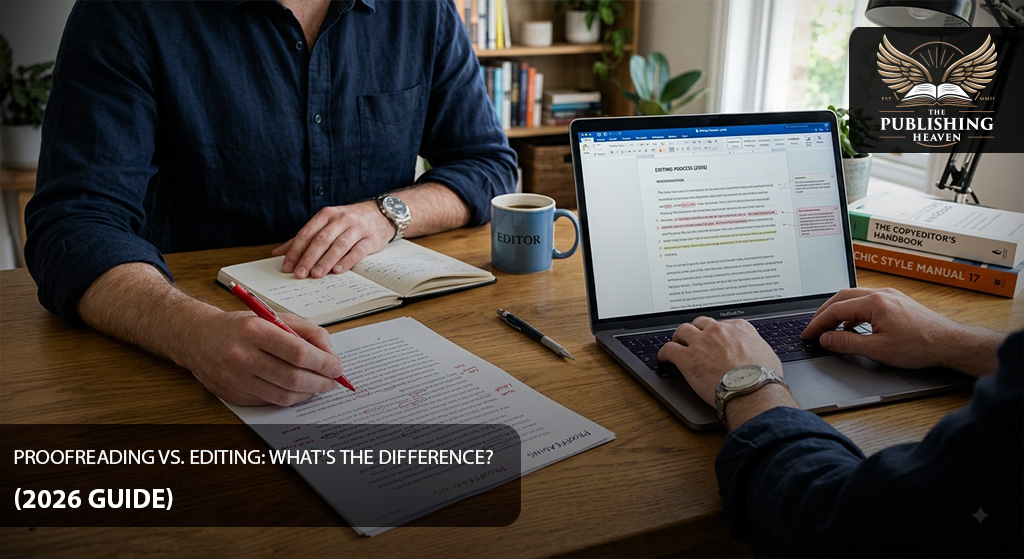
You have finally finished writing your book. You have poured your heart into every chapter, revised until your eyes blurred, and now you are ready to get professional help. But then you see the options: editing and proofreading. What is the difference? Which one do you actually need?
This is one of the most common questions authors ask. And the answer matters more than you might think. Choosing the wrong service can waste your money and delay your publication.
Here is the problem: Many authors use the terms “editing” and “proofreading” interchangeably. But they are completely different services that happen at different stages of the writing process. Editing improves the quality of your writing. Proofreading polishes the final product. If you hire a proofreader when you actually need an editor, you will end up with a clean manuscript that still has structural problems, confusing passages, and weak prose.
Why this matters: Professional editing and proofreading are essential investments for any serious author. According to industry experts, a document that has been edited will still need to be proofread by someone who goes through the text with a fine-tooth comb. Skipping either step can leave your book looking unprofessional and cost you readers.
In this article, you will learn:
- The exact difference between editing and proofreading
- The three types of editing and which one your manuscript needs
- When to hire an editor versus a proofreader
- How much each service costs
- Common mistakes authors make
- How to choose the right professional for your project
By the end of this guide, you will know exactly which service your manuscript needs and when to hire it.
Table of Contents
- What Is the Difference Between Editing and Proofreading?
- What Is Editing?
- What Is Proofreading?
- Comparison Table: Editing vs. Proofreading
- The Three Types of Editing
- When Should You Hire an Editor?
- When Should You Hire a Proofreader?
- How Much Do Editing and Proofreading Cost?
- Common Mistakes Authors Make
- Frequently Asked Questions (FAQs)
- Ready to Get Your Book Professionally Edited or Proofread?
What Is the Difference Between Editing and Proofreading?
Editing and proofreading are distinct but complementary stages in the writing process. The main difference comes down to scope and timing.
Editing involves a comprehensive review of content, structure, style, and organization. Editors focus on refining clarity, coherence, and overall effectiveness. They often make substantial changes to enhance the quality and impact of your writing.
Proofreading is a narrower task focused on correcting surface-level errors such as grammar, spelling, punctuation, and formatting. Proofreaders meticulously examine the text for typographical mistakes and inconsistencies. They ensure the document adheres to formatting guidelines.
The timing also differs. Editing is typically completed throughout the writing process, especially between drafts. It often suggests contextual changes that affect the overall meaning and presentation. Proofreading occurs later in the writing process, usually just after the final editing and before the final draft is presented for publication.
In short: editing makes your writing better; proofreading makes it correct.
What is Editing?
Editing encompasses a broader range of tasks and involves reviewing the content, structure, and overall effectiveness of the writing. It goes beyond surface-level errors to address the clarity, coherence, organization, and presentation of ideas.
Content Review
During editing, you evaluate the logical flow of ideas, the strength of arguments, the relevance of supporting evidence, and the overall structure of the paper. You may make substantial changes, such as reorganizing paragraphs, clarifying complex concepts, and refining the overall message.
Style and Tone
Editing includes improving the writing style and ensuring a consistent tone throughout the paper. Editors might suggest changes to sentence structures, rephrase sentences for better clarity, and enhance overall readability.
Content Enhancement
Editing involves adding, deleting, or revising content to improve the quality and impact of the paper. Editors might expand on ideas, provide more examples, or strengthen weak arguments.
Fact-Checking and Accuracy
Editors often verify the accuracy of the facts, data, and references used in the paper to ensure the information presented is reliable and credible.
Substantive Changes
Editing can involve substantive changes that affect the paper’s overall meaning and structure. It requires a deep understanding of the subject matter and the writing’s goals.
What is Proofreading?
Proofreading is the careful review of a text for errors, especially surface errors such as spelling, punctuation, grammar, formatting, and typing.
Error Correction
During proofreading, you meticulously review the text to correct typographical errors, misspellings, incorrect punctuation, and formatting inconsistencies.
Content Evaluation
Proofreading does not involve evaluating the content, structure, or organization of the paper. It focuses solely on the text’s correctness.
Line-Level Review
Proofreading is often done line by line, carefully examining each sentence for errors and inconsistencies.
Formatting and Layout
Proofreaders ensure that the document adheres to the required formatting style and that headings, subheadings, fonts, margins, and spacing are consistent.
Final Check
Proofreading is typically the last step before the document is considered final and ready for submission or publication.
Comparison Table: Editing vs. Proofreading
| Aspect | Editing | Proofreading |
| Scope | Broad: content, structure, style, flow | Narrow: surface errors, typos, punctuation |
| Timing | Throughout the writing process, between drafts | Final step before publication |
| Changes | Substantial: reorganizing, rewriting, clarifying | Minor: correcting errors |
| Focus | Improving quality and impact | Ensuring correctness and consistency |
| Collaboration | Requires author communication | Minimal to no collaboration |
| Word Count | May reduce word count | Does not reduce word count |
| Goal | Better writing | Error-free writing |
The Three Types of Editing
Not all editing is the same. There are three distinct levels of editing, each serving a different purpose.
1. Substantive (Developmental) Editing
This is the deepest level of editing. A substantive editor looks at your story arc, pacing, the structure of your scenes and chapters, and your character development throughout your novel.
What they do: Identify inconsistencies, missing information, or plot holes. They look for repetitiveness and ensure readability and flow. They may suggest major rewrites or reorganizations.
When you need it: Your manuscript is complete, but you sense structural problems. You need help with organization, substance, tone, and overall effectiveness.
2. Line Editing
Line editing is a page-by-page review of your writing for consistency, clarity, and tone. It ensures your writing flows engagingly for your audience from line to line.
What they do: Look at word choice, sentence structure, dialogue, and tone. They polish your prose without changing the overall structure.
When you need it: Your structure is solid, but your prose feels clunky, repetitive, or lacks elegance.
3. Copy Editing
Copy editing provides the final review of grammar, spelling, punctuation, and style on a more mechanical level before formatting. It falls somewhere between substantive editing and catching technical mishaps.
What they do: Correct grammar, spelling, punctuation, and consistency errors. Ensure your manuscript adheres to a consistent style guide.
When you need it: Your manuscript is structurally sound, and you are ready to polish the language for publication.
When Should You Hire an Editor?
You may not be ready for proofreading if you need assistance with readability, clarity, flow, tone, and coherency. You should hire an editor when you are not confident in your basic grammar, spelling, and punctuation, or when you struggle with syntax.
You might also need an editor if you want assurance that your writing is good and professional, or if you feel bored or frustrated with self-editing and would like to engage neutral help to assess the presentation of your manuscript.
Signs you need editing:
- Your manuscript has structural problems or plot holes
- You are unsure about organization and flow
- Your writing lacks clarity or consistency
- You need help with tone and voice
- You want to improve overall quality before publication
When Should You Hire a Proofreader?
You will know you are ready to move on to proofreading if you are confident with your manuscript and only require a basic proof. Your final check requires just the correction of misspellings, punctuation errors, and typos.
You should hire a proofreader when you have already completed the editing process and have no more revisions or changes. You feel satisfied with your writing and wish to submit your manuscript in its current state.
Signs you need proofreading:
- Your manuscript has been professionally edited
- You have completed all major revisions
- You only need to catch typos and grammatical errors
- Your manuscript is formatted and ready for publication
- You want a final quality check before printing
How Much Do Editing and Proofreading Cost?
Professional editing and proofreading services typically charge by the word. Here are general estimates for an 80,000-word manuscript:
Editing Costs:
- Developmental editing: $2,400–$2,800
- Line editing: $2,160–$2,800
- Copy editing: $1,600–$2,160
Proofreading Costs:
- Proofreading: $960–$1,600
These estimates are based on industry averages from the Editorial Freelancers Association. Actual rates vary based on editor experience, genre complexity, and turnaround time.
Common Mistakes Authors Make
Many authors make costly mistakes in editing and proofreading. Here are the most common ones to avoid.
Mistake 1: Thinking You Can Do It Yourself
It is challenging to edit or proofread your own work. Authors are too close to their work to catch all errors and structural problems. That is why professional editors and proofreaders exist.
Mistake 2: Hiring a Proofreader When You Need an Editor
If you hire a proofreader for a manuscript that has structural problems, you will end up with a clean manuscript that still has confusing passages and weak prose. You would waste time and money polishing words that might later be cut or rewritten.
Mistake 3: Skipping Proofreading Entirely
Even after professional editing, a manuscript still needs to be proofread before publication. In publishing, a document that has been edited will still need to be proofread by someone who will go through the text with a fine-tooth comb.
Mistake 4: Combining Editing and Proofreading
Generally, you should separate the editing and proofreading processes into distinct stages rather than attempting to do them at the same time. Editing and proofreading require different approaches, and combining them can lead to missed errors or missed opportunities for content improvement.
Frequently Asked Questions (FAQs)
Is editing the same as proofreading?
No. Editing involves reviewing content, structure, style, and organization. Proofreading focuses on correcting surface-level errors, such as grammar, spelling, punctuation, and formatting.
Which comes first, editing or proofreading?
Editing comes first. You should complete all editing and revisions before proofreading. Proofreading is the final check before publication.
Can I edit and proofread my own book?
It is challenging. Authors are too close to their work to catch all errors and structural problems. That is why professional editors and proofreaders exist.
Do I need both editing and proofreading?
Yes. Both play vital roles in producing a polished and professional piece of writing. Editing improves the quality of your writing. Proofreading ensures it is error-free.
How long does editing and proofreading take?
Timelines vary. A copy edit typically takes 2 to 4 weeks for an 80,000-word manuscript. Proofreading is usually quicker, taking 1 to 2 weeks for the same length. Developmental editing may take longer due to rewrites.
How do I find a professional editor or proofreader?
Look on reputable platforms like Reedsy, the Editorial Freelancers Association, or contact professional publishing services like The Publishing Heaven. Our team offers both editing and proofreading services tailored to your project.
What is the difference between copy editing and proofreading?
Copy editing corrects grammar, spelling, and consistency issues. Proofreading is the final check for typos and formatting errors after the manuscript is typeset.
Can an editor help with book formatting?
Many editors do not handle formatting, but some publishing services do. At The Publishing Heaven, we offer both book editing and book formatting services to prepare your manuscript for publication.
Ready to Get Your Book Professionally Edited or Proofread?
Do not let weak editing or typos hold your book back. Whether you need developmental feedback, line editing, copy editing, or proofreading, working with a professional is the single most important step you can take before publication.
At The Publishing Heaven, we offer a full range of editorial services to help you polish your manuscript and prepare for publication. Our editors bring years of experience in genres ranging from fiction and memoir to business and self-help.
Here is how we can help you:
- Ghostwriting – Get professional help writing your book from scratch.
- Book Editing – Developmental, line, copy editing, and proofreading.
- Proofreading – Final polish before publication.
- Book Formatting – Professional interior layout for print and eBook.
- Typesetting – High-quality typography for a polished look.
- Cover Design – Eye-catching covers that sell.
- Book Publishing – End-to-end publishing support.
- Book Marketing – Promote your book to the right audience.
Contact us today for a free consultation. Let us discuss how we can help you get your book ready for the world.
