
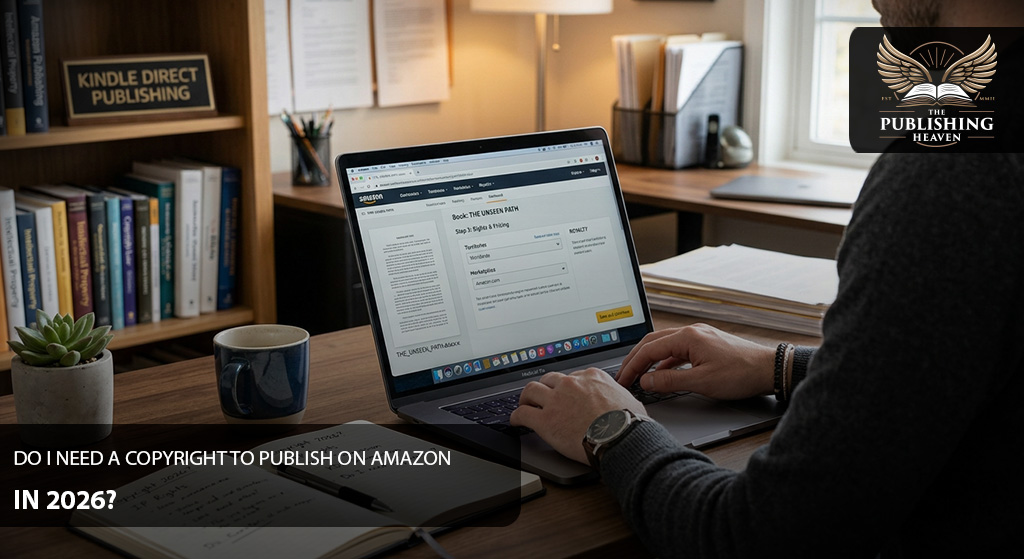
Do you need a copyright to publish on Amazon in 2026? You generally do not need to register your copyright before publishing an original book through Amazon Kindle Direct Publishing. However, Amazon requires you to own or control the necessary publishing rights for your manuscript and other protected content.
Fortunately, copyright protection and copyright registration serve different purposes. In the United States, copyright generally begins when an author creates an original work and records it in a tangible form. Therefore, you can usually publish your manuscript without first obtaining a registration certificate.
Nevertheless, understanding your publishing rights remains essential. Previously published manuscripts, ghostwritten books, and licensed illustrations may involve different ownership arrangements. Moreover, copyright registration can offer legal advantages even when Amazon does not require it.
Authors seeking professional support can explore The Publishing Heaven and 360 Book Marketeers. Similarly, Global Book Distributors and KDP Publishing Team offer additional publishing-related services.
This guide explains Amazon’s copyright requirements in 2026. Additionally, it covers copyright ownership, registration, publishing agreements, public-domain content, ISBNs, and practical ways to protect your book.
Do You Need a Copyright to Publish on Amazon?
Amazon KDP does not routinely require authors to submit copyright registration certificates.
Instead, the platform requires publishers to possess the legal rights necessary to distribute their content. Consequently, authors should confirm ownership and permissions before uploading their manuscripts.
For example, suppose you write an original novel independently. Your qualifying creative expression generally receives automatic copyright protection under U.S. law. Therefore, you can usually publish your book without completing formal registration beforehand.
However, using someone else’s protected writing or artwork creates additional responsibilities. You must have the appropriate permission, license, or another valid legal basis.
Furthermore, Amazon may request documentation when it needs to verify publishing rights.
The official Amazon KDP Intellectual Property Rights FAQ explains these requirements.
Why Publishing Rights Matter
Publishing rights determine who can legally reproduce and distribute a creative work.
For instance, an author might retain copyright ownership while granting a traditional publisher exclusive distribution rights.
In that situation, the publishing agreement may restrict independent publication through KDP.
Similarly, an illustrator may license artwork for a paperback without authorizing other commercial uses.
Therefore, review your agreements before selecting publication formats or distribution territories.
Copyright vs. Copyright Registration
Copyright and copyright registration are related but distinct legal concepts.
Copyright protects qualifying original creative expression. Meanwhile, registration establishes an official record of a copyright claim.
In the United States, copyright generally exists automatically once an original work meets the legal requirements for protection.
For example, saving your original manuscript as a document can satisfy the requirement to record the work in a tangible form.
However, automatic protection does not provide every advantage associated with registration.
What Copyright Protects
Copyright may protect original books, poems, photographs, illustrations, and other creative works.
However, it generally does not protect basic ideas, titles, names, or short phrases.
For example, the general idea of a detective investigating a mystery does not belong exclusively to one author.
Nevertheless, the author’s original dialogue, descriptions, and storytelling may receive protection.
Therefore, distinguish your creative expression from the underlying concept.
What Copyright Registration Provides
Registration creates a public record of a copyright claim.
Additionally, timely registration may offer important enforcement advantages.
For example, U.S. law generally requires registration or refusal of registration before someone can file an infringement lawsuit involving a U.S. work.
Furthermore, registration timing can influence eligibility for statutory damages and attorney fees.
The U.S. Copyright Office explains these legal distinctions in greater detail.
Does Amazon Require Copyright Registration?
No, Amazon does not make formal copyright registration a standard publishing requirement.
However, KDP requires authors to confirm their publishing rights during title setup.
Additionally, authors must identify territories where they hold distribution rights.
Therefore, your publishing choices should reflect your actual ownership and licensing arrangements.
Can Amazon Request Proof of Ownership?
Yes, Amazon may ask for documentation in certain circumstances.
For example, a previously published manuscript may require evidence showing that the author’s publishing rights have reverted.
Similarly, a book created by another person may require an agreement establishing publication rights.
Consequently, preserve contracts, licensing agreements, and other relevant records.
However, Amazon generally requests these documents when necessary rather than accepting them for advance review.
What Publishing Rights Does KDP Require?
KDP expects publishers to possess the rights necessary to distribute their submitted material.
For example, you may own your manuscript while licensing photographs from another creator.
In this situation, your license must permit the intended commercial use.
Additionally, the agreement should cover the relevant publication formats and territories.
Therefore, verify your rights for both print and digital editions when applicable.
Worldwide Rights vs. Individual Territories
Amazon offers worldwide distribution options when authors hold the required rights.
However, some contracts limit publication to particular countries or regions.
For example, a publisher may control exclusive rights in one territory while the author retains rights elsewhere.
Consequently, selecting worldwide rights without proper authorization could violate an existing agreement.
Therefore, choose only the territories your rights actually cover.
Amazon’s eBook Distribution Rights Guide explains these options.
Do You Need a Copyright Page in Your Amazon Book?
Amazon does not require authors to include a copyright page.
However, many publishers add one to identify the copyright owner and present essential publication information.
A copyright page may contain the owner’s name, publication year, rights statement, publisher details, and ISBN when applicable.
Additionally, it may identify contributors or acknowledge licensed material.
Does a Copyright Page Prove Ownership?
No, a copyright page does not establish ownership of material belonging to someone else.
For example, adding your name to a rights statement cannot transfer another writer’s copyright.
Likewise, Amazon does not consider the copyright page sufficient proof when it requests ownership documentation.
Therefore, maintain separate records supporting your publishing rights.
When Should You Register Your Copyright?
Although copyright registration is not mandatory for obtaining protection, it may benefit certain authors.
For example, writers expecting significant commercial sales may value the additional legal advantages.
Similarly, authors planning adaptations, licensing agreements, or international distribution may want clearer ownership records.
However, the appropriate decision depends on the circumstances and applicable law.
Benefits of Registration Before Publication
Early registration can establish a formal ownership claim.
Additionally, timely registration may help preserve access to certain legal remedies.
For example, U.S. copyright law has registration timing rules that affect eligibility for statutory damages.
Therefore, authors concerned about infringement should examine these requirements before publication.
You can review the official Copyright Registration Portal.
Does Every Author Need Registration?
Not necessarily.
An independent author might publish an original book without registering it immediately.
Meanwhile, another writer may prioritize formal registration because of valuable licensing opportunities.
Furthermore, copyright laws differ internationally.
Consequently, authors with complicated ownership situations should consider qualified legal advice.
What If Someone Else Helped Write Your Book?
Books often involve several creative contributors.
For example, authors may collaborate with editors, illustrators, translators, photographers, or co-writers.
However, each professional relationship can involve different ownership rights.
An editor who corrects grammar does not necessarily become a copyright owner. Conversely, a co-author who contributes original creative expression may have ownership interests.
Therefore, clarify the rights associated with each contribution before publishing.
Establish Written Contributor Agreements
First, identify each contributor’s responsibilities.
Next, determine whether the contributor transfers ownership or grants specific permissions.
Additionally, address publication formats, territories, and future adaptations.
For example, an illustrator might authorize printed book reproduction but reserve merchandising rights.
Therefore, ensure the agreement covers your intended publishing activities.
What About Ghostwritten Books?
Ghostwriting involves one person creating manuscript content for another individual or organization.
However, copyright ownership depends on the applicable laws and contractual arrangements.
Therefore, paying a ghostwriter does not automatically resolve every ownership question.
Instead, establish the intended rights through a written agreement.
What Should a Ghostwriting Contract Include?
A ghostwriting agreement should identify the parties and describe the project.
Additionally, it should address manuscript ownership, copyright assignment or licensing, compensation, and publication permissions.
For example, the agreement may grant the client exclusive rights to publish, revise, and distribute the finished manuscript.
Furthermore, it should clarify whether the ghostwriter retains any relevant rights.
Authors seeking writing support can explore ghostwriting services.
However, contractual questions involving intellectual property may require an attorney.
Can You Publish Public-Domain Books on Amazon?
Amazon allows certain public-domain publications through KDP.
However, you must verify that the original material genuinely belongs to the public domain.
For example, an older novel may no longer have copyright protection in one country. Nevertheless, its copyright status could differ elsewhere.
Additionally, modern translations and illustrations may have separate copyrights.
Therefore, investigate every component before preparing your publication.
Amazon’s Public-Domain Publishing Rules
Amazon applies additional requirements to public-domain titles.
For example, KDP may require meaningful differences between a proposed edition and existing versions.
Qualifying differences can include original annotations, translations, or illustrations.
However, simple formatting improvements generally do not establish sufficient differentiation.
Consequently, review the official KDP Public-Domain Publishing Guidelines before submitting your book.
Can You Publish a Previously Published Book on Amazon?
Yes, you can republish a book through KDP when you hold the necessary rights.
However, earlier publishing contracts may restrict independent distribution.
For example, a traditional publisher might retain exclusive paperback rights while the author controls the digital edition.
Alternatively, another agreement could limit publication to specific territories.
Therefore, examine your previous contracts carefully before uploading an existing title.
Review Your Existing Publishing Agreements
First, determine which rights you previously granted.
Next, identify whether those rights remain active.
Additionally, examine any termination or rights-reversion provisions.
If your rights have reverted, keep the relevant confirmation documents.
Furthermore, verify whether the earlier agreement applies to new editions or alternative formats.
This preparation can help prevent disputes over previously published material.
What If You Use Someone Else’s Content?
Including third-party content requires careful rights management.
For example, books may contain photographs, poems, illustrations, maps, song lyrics, or quotations.
However, publicly accessible material does not automatically qualify for unrestricted use.
Therefore, establish the copyright status before reproducing protected content.
Additionally, confirm that any license covers your intended publication.
Understand Commercial Licensing
A license permits specific uses of another person’s intellectual property.
For example, a stock photograph license might authorize commercial book covers while limiting other uses.
Similarly, certain illustrations may require attribution or impose reproduction restrictions.
Consequently, read the complete licensing terms before incorporating outside material.
Furthermore, retain proof of your authorization.
Can You Use Short Quotes Without Permission?
Sometimes, but the answer depends on the circumstances.
For example, U.S. fair use law considers the purpose, nature, amount, and market effect of the use.
However, no universal word count automatically makes every quotation permissible.
Additionally, legal exceptions differ across jurisdictions.
Therefore, evaluate quotations individually and obtain permission when necessary.
Does an ISBN Protect Your Book?
No, an ISBN does not provide copyright protection.
An International Standard Book Number identifies a particular edition or publishing format.
Copyright, meanwhile, concerns the legal rights associated with original creative expression.
Therefore, purchasing an ISBN does not establish ownership of your manuscript.
Similarly, copyright registration does not replace an ISBN where one is required.
ISBN Requirements for Amazon Publishing
KDP applies different ISBN rules to different formats.
For example, Kindle eBooks do not require an ISBN.
However, standard paperback and hardcover editions generally need one.
Amazon also offers free ISBNs for eligible print books. Low-content books follow a separate exception.
Therefore, review the official KDP ISBN Guidelines before selecting your publishing format.
How to Protect Your Book Before Publishing on Amazon
Understanding copyright to publish on Amazon can help authors avoid ownership disputes and preventable delays.
Although no single action eliminates every risk, careful preparation creates a stronger rights record.
The following table outlines ten practical measures authors can take.
| Step | Protection Measure | Recommended Action |
|---|---|---|
| 1 | Preserve Original Manuscripts | Save your initial drafts and completed files. |
| 2 | Document Your Writing Process | Maintain dated revisions and development records. |
| 3 | Clarify Contributor Ownership | Establish agreements with co-authors and other contributors. |
| 4 | Review Ghostwriting Contracts | Confirm copyright ownership and publication rights. |
| 5 | Verify Third-Party Content | Check permissions for images, writing, and illustrations. |
| 6 | Retain Licensing Documents | Store commercial licenses and permission agreements. |
| 7 | Examine Previous Contracts | Identify existing publication restrictions. |
| 8 | Confirm Distribution Territories | Select regions covered by your legal rights. |
| 9 | Consider Copyright Registration | Evaluate registration benefits and timing. |
| 10 | Review KDP Requirements | Check Amazon’s intellectual property and publishing policies. |
Keep Your Publishing Records Organized
Start by creating a dedicated location for important publishing documents.
Next, save your manuscript drafts, contracts, and licensing records.
Additionally, preserve signed agreements showing transfers or grants of rights.
For example, a copyright assignment may help establish ownership of commissioned creative work.
However, an invoice alone may not prove that the creator transferred copyright.
Therefore, review the underlying agreement rather than relying solely on payment records.
Review Amazon’s Content Guidelines
Before publishing, check whether your manuscript meets KDP’s current standards.
Amazon prohibits content that violates applicable intellectual property rights.
Additionally, KDP requires disclosure of AI-generated text, images, and translations.
However, its policy distinguishes AI-generated content from AI-assisted work.
For example, an author who uses AI solely to proofread original writing generally does not need the same disclosure.
Therefore, consult the KDP Content Guidelines before submitting your files.
How to Register a Copyright Before Publishing
Authors seeking U.S. copyright registration can apply through the U.S. Copyright Office.
First, identify the work you intend to register.
Next, select the appropriate registration category.
Then, complete the application and pay the applicable fee.
Additionally, submit the required deposit material.
However, filing requirements may differ according to the work and publication circumstances.
Choose the Appropriate Registration Category
Original manuscripts generally fall within the literary works category.
However, illustrated books may contain different types of creative expression.
For example, a publication could include both original writing and separately created artwork.
Therefore, review the registration instructions to determine which claims your application can cover.
Understand Registration Timing
Registration processing times vary.
Additionally, incomplete applications may require further information.
Therefore, check the official instructions before filing.
Once the Copyright Office approves an eligible application, it issues a registration record.
However, registration cannot automatically resolve an existing ownership dispute.
Consequently, confirm the accuracy of your ownership claim before submitting it.
Common Copyright Mistakes to Avoid
Copyright problems often arise when authors misunderstand their rights.
For example, someone may assume that purchasing an illustration grants unlimited commercial use.
Similarly, a writer might republish a manuscript without reviewing an earlier agreement.
Therefore, watch for the following mistakes.
Copying Content From Websites
Online availability does not establish public-domain status.
Consequently, verify the ownership and licensing terms of outside materials.
Additionally, remember that attribution alone does not automatically authorize reproduction.
Assuming a Copyright Page Establishes Ownership
A copyright page can communicate an ownership claim.
However, it cannot transfer rights from another creator.
Therefore, rely on valid agreements and appropriate evidence.
Ignoring Previous Publishing Contracts
An earlier publisher may still control certain rights.
For example, an exclusive agreement could restrict distribution through Amazon.
Consequently, check contractual obligations before republishing your book.
Relying on Verbal Ghostwriting Agreements
Unclear ghostwriting arrangements can create ownership disputes.
Therefore, document the intended rights in a written contract.
Additionally, address future revisions and commercial adaptations.
Assuming Older Books Are Automatically Public Domain
Copyright duration depends on several factors.
Moreover, a newer translation or illustration may have separate protection.
Therefore, verify the legal status of the specific material you intend to publish.
Selecting Worldwide Rights Without Permission
International distribution can increase your potential audience.
However, you must possess the relevant territorial rights.
Consequently, match your KDP distribution choices to your actual agreements.
Frequently Asked Questions About Copyright and Amazon Publishing
Do I Need a Copyright to Publish on Amazon?
You generally do not need formal copyright registration before publishing an original book through Amazon KDP. However, you must possess the necessary publishing rights.
Does Amazon Require a Copyright Registration Certificate?
No, Amazon does not routinely require a registration certificate. Nevertheless, the platform may request other documentation when verifying your rights.
Does Amazon Require a Copyright Page?
No, a copyright page is optional under KDP’s standard publishing requirements. However, including one can help identify the copyright owner.
Does Amazon Automatically Copyright My Book?
No, publishing through Amazon does not itself create copyright protection. Instead, applicable law determines when original creative work receives protection.
Should I Register My Copyright Before Publishing?
Registration is not mandatory for obtaining U.S. copyright protection. However, timely registration may provide enforcement benefits worth considering.
Can I Publish Someone Else’s Book on Amazon?
You may publish protected material belonging to another person when you have the necessary publishing rights or another valid legal basis. Additionally, Amazon may request supporting documentation.
Can I Republish a Book From Another Publisher?
Yes, provided you hold the relevant rights. Therefore, check your earlier publishing agreement before releasing another edition.
Does an ISBN Give Me Copyright Protection?
No, an ISBN identifies a book edition. It does not establish ownership or provide the legal benefits of copyright registration.
Can I Use Copyrighted Images in My Amazon Book?
You may use protected images when appropriate permission, licensing, or a valid legal exception allows the intended use. Consequently, check the terms carefully.
What Happens If I Publish Content Without Permission?
Amazon may reject or remove the publication. Additionally, infringement can create legal exposure and affect your account status.
Do I Need Copyright Registration for a Ghostwritten Book?
Not necessarily. However, a clear written contract should establish the manuscript’s ownership and publishing permissions.
Does Copyright Law Work the Same Way Worldwide?
No, copyright laws and enforcement procedures vary by jurisdiction. Therefore, international authors should review the rules relevant to their circumstances.
Can I Register My Copyright After Publishing?
Yes, U.S. copyright registration can generally occur after publication. However, filing timing can affect eligibility for certain remedies.
Can I Publish a Book Without an ISBN?
Yes, Kindle eBooks do not require ISBNs through KDP. Additionally, certain low-content books can publish without one. Standard print editions generally require ISBNs.
Can I Publish a Book With AI-Generated Content?
KDP permits qualifying AI-generated content that complies with its policies. However, publishers must disclose AI-generated text, images, and translations.
Can I Copyright My Book Title?
Copyright generally does not protect titles or short phrases. However, trademark law may offer protection for certain distinctive branding elements.
Conclusion
Understanding copyright to publish on Amazon in 2026 helps authors make informed decisions about publishing rights and legal protection.
First, remember that Amazon does not ordinarily require formal copyright registration. However, you must own or control the rights necessary to distribute your book.
Next, review agreements involving contributors, publishers, and third-party materials.
Additionally, retain contracts, permissions, and licensing records that support your publishing rights.
If your manuscript involves ghostwriting or previous publication agreements, resolve potential ownership issues before uploading it.
Furthermore, consider whether copyright registration offers relevant legal advantages for your work.
For official guidance, consult the Amazon KDP Intellectual Property Rights FAQ and the U.S. Copyright Office.
Once you have confirmed your rights, you can prepare your manuscript through Amazon Kindle Direct Publishing.
Additionally, authors seeking professional publishing assistance can explore The Publishing Heaven for writing, editing, formatting, and publishing services. Similarly, 360 Book Marketeers offers book marketing solutions, while Global Book Distributors provides distribution services. Furthermore, KDP Publishing Team offers additional support for authors navigating the self-publishing process.
Ultimately, responsible self-publishing requires more than preparing an attractive book. By understanding ownership, licensing, and copyright requirements, you can reduce legal risks and build a stronger publishing foundation.
