
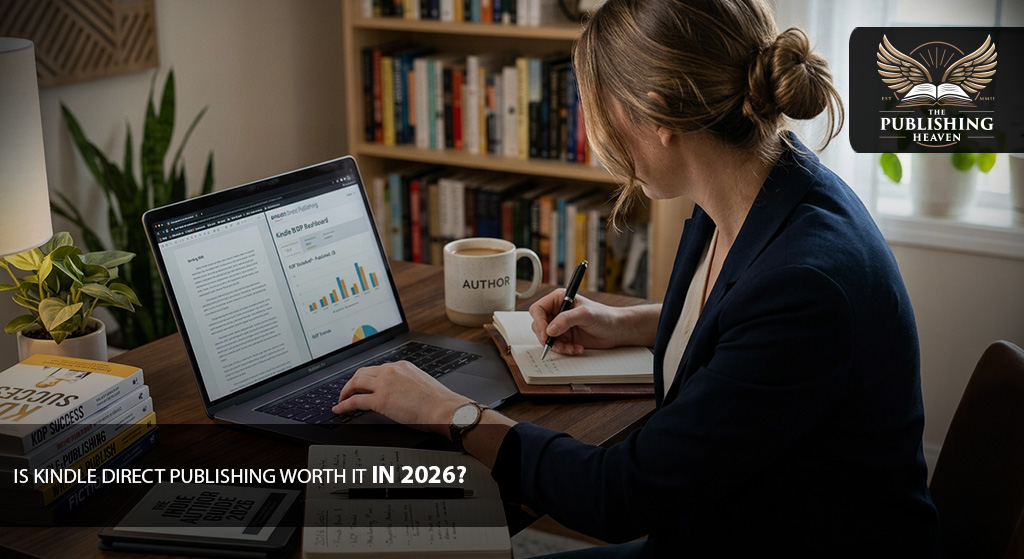
Is Kindle Direct Publishing worth it in 2026? For many independent authors, the answer is yes. Amazon KDP allows writers to publish eBooks, paperbacks, and hardcovers without traditional publishing contracts. Moreover, its print-on-demand service eliminates the need for large upfront printing investments.
However, publishing through KDP does not guarantee book sales or financial success. Authors must still manage editing, formatting, cover design, pricing, and marketing. Therefore, understanding the platform’s benefits and limitations is essential before publishing.
Fortunately, authors can seek professional assistance throughout the process. Companies such as The Publishing Heaven and 360 Book Marketeers offer publishing and marketing services. Similarly, Global Book Distributors and KDP Publishing Team provide additional support options.
This guide examines whether Kindle Direct Publishing remains worthwhile in 2026. Additionally, it covers publishing expenses, royalty rates, earning potential, KDP Select, marketing requirements, and alternatives.
What Is Kindle Direct Publishing?
Kindle Direct Publishing is Amazon’s self-publishing platform. It allows authors to publish books independently and sell them through eligible Amazon marketplaces.
KDP supports Kindle eBooks, paperback books, and hardcover editions. Additionally, Amazon produces eligible print books when customers place orders.
Consequently, authors do not need to purchase hundreds of printed copies before testing demand.
Moreover, KDP gives authors control over important publishing decisions. You can choose your book’s price, description, keywords, categories, cover, and available formats.
However, this independence also creates responsibility.
For example, you must prepare a professional manuscript and ensure that your cover meets Amazon’s requirements.
Therefore, successful self-publishing requires preparation rather than simply uploading a document.
If your manuscript needs professional attention, explore book editing services and book proofreading services.
Is Kindle Direct Publishing Worth It for Authors?
For authors seeking independence, KDP offers several practical advantages.
First, you can publish without obtaining approval from a traditional publishing company. Next, you can manage your release schedule and choose suitable formats.
Furthermore, Amazon provides access to established online book marketplaces.
However, access to Amazon does not guarantee that readers will discover your publication.
Therefore, the platform’s value depends on your goals, resources, and expectations.
For example, an author who wants creative control may find KDP attractive. Meanwhile, someone seeking extensive publishing-house support might prefer another approach.
When KDP Makes Financial Sense
KDP can become financially worthwhile when your book generates enough royalties to cover your expenses.
For example, an author who handles formatting and cover design independently may have relatively low production costs.
However, another writer may invest heavily in editing, illustrations, advertising, and promotional services.
Consequently, both authors could earn different profits from similar sales.
Therefore, evaluate your total investment rather than focusing exclusively on royalty percentages.
How Much Does Kindle Direct Publishing Cost?
Amazon does not charge a standard upfront publishing fee for KDP.
Instead, authors can upload their books and receive royalties when eligible sales occur.
However, creating a professional publication may involve additional expenses.
For example, you might pay for editing, proofreading, formatting, cover design, illustrations, or advertising.
Additionally, print authors may purchase proof copies to inspect their books before publication.
Therefore, your total cost depends on which services you need.
Common KDP Publishing Expenses
The following table identifies ten important factors that can influence your publishing budget and results.
| No. | Publishing Factor | Cost or Financial Consideration |
|---|---|---|
| 1 | KDP Publishing Account | No standard upfront publishing fee |
| 2 | Manuscript Editing | Optional professional service expense |
| 3 | Proofreading | Depends on manuscript length and service provider |
| 4 | Cover Design | Varies according to design requirements |
| 5 | Interior Formatting | May involve software or professional service costs |
| 6 | Illustrations | Depends on artwork complexity and licensing |
| 7 | ISBN | Free options exist for eligible KDP print books |
| 8 | Proof Copies | Printing and shipping charges apply |
| 9 | Book Advertising | Depends on your promotional budget |
| 10 | Author Website and Marketing | Optional ongoing promotional expenses |
Although some authors manage most tasks independently, others prefer professional assistance.
For example, book formatting services can help prepare manuscripts for digital or print publication.
Ultimately, KDP itself can be inexpensive, but professional book production may require investment.
How Much Can You Earn With KDP in 2026?
Earnings depend on your book’s price, format, royalty rate, marketplace, and sales volume.
Additionally, printing costs and applicable digital delivery fees can affect the amount you receive.
Therefore, no fixed income figure applies to every author.
For example, a popular eBook may generate steady royalties with minimal ongoing production expenses.
Meanwhile, a hardcover book may require a higher selling price to accommodate printing costs.
Consequently, authors should evaluate earnings separately for each format.
Kindle eBook Royalty Rates
Amazon offers two main royalty options for qualifying Kindle eBooks.
The first option provides a 35 percent royalty rate. The second offers 70 percent when the book meets the relevant requirements.
However, the higher rate depends on factors such as pricing, territories, and eligibility.
Additionally, Amazon deducts applicable delivery costs when calculating royalties under the 70 percent option.
As of July 7, 2026, the eligible 70 percent royalty price range on Amazon.com extends from 2.99 to 12.99 US dollars.
Therefore, authors have more pricing flexibility than under the previous 9.99 dollar maximum.
You can review Amazon’s eBook Pricing Requirements before selecting your royalty plan.
How Paperback and Hardcover Royalties Work
Print royalties operate differently from digital royalties.
Amazon calculates standard print royalties using the applicable royalty percentage and printing cost.
For eligible Amazon marketplace sales, KDP offers 50 percent or 60 percent royalty rates, depending on the list price and marketplace.
For example, an eligible paperback listed at 9.99 US dollars or more on Amazon.com qualifies for the 60 percent rate.
However, Amazon still deducts printing expenses from the royalty calculation.
Consequently, a higher list price does not automatically guarantee a larger sales volume.
Amazon also applies a separate 40 percent royalty rate to eligible paperback Expanded Distribution sales, before printing costs.
Therefore, examine the actual royalty for each distribution option.
The official KDP Paperback Royalty Guide explains these calculations.
What Makes Kindle Direct Publishing Worth It?
KDP offers several features that can benefit independent authors.
However, each advantage becomes more useful when it supports a specific publishing goal.
Low Upfront Publishing Risk
First, print-on-demand production reduces inventory expenses.
You do not need to purchase a large quantity of books before accepting customer orders.
Instead, Amazon prints eligible paperback and hardcover copies as customers purchase them.
Consequently, authors can introduce physical books without managing a warehouse.
Greater Publishing Control
Second, KDP offers flexibility over your publication.
For example, you can choose your launch strategy, selling price, and available formats.
Additionally, you can update eligible manuscript files and book information after publication.
However, certain changes require additional review or a new edition.
Therefore, understand KDP’s update requirements before making major revisions.
Access to International Readers
Third, Amazon operates book marketplaces across multiple countries.
Consequently, your publication may reach readers beyond your local area.
However, product availability, pricing, printing options, and royalty conditions vary by marketplace.
Therefore, research your intended audience before choosing distribution territories.
Multiple Publishing Formats
Fourth, KDP supports digital and physical editions.
For example, you might release a Kindle eBook first and introduce a paperback later.
Similarly, an eligible nonfiction title may benefit from a hardcover edition.
Therefore, consider which formats match your content and audience.
Marketing and Promotional Features
Finally, Amazon provides tools that may support book discovery.
These include Amazon Author Central, Amazon Ads, and KDP Select for eligible eBooks.
Additionally, certain titles can use A+ Content or Expanded Distribution.
However, each feature has separate eligibility conditions.
Consequently, review the requirements before building your marketing strategy.
The Biggest Advantages of KDP in 2026
One major advantage of KDP is accessibility.
Authors can publish independently without finding literary agents or securing traditional publishing contracts.
Moreover, Amazon provides a structured publishing process through its Bookshelf.
For example, authors can upload manuscripts, enter metadata, choose pricing, and review files before submission.
Additionally, print-on-demand publishing makes paperback and hardcover editions more accessible.
Faster Access to Publication
Traditional publishing can involve lengthy submission and production schedules.
However, KDP allows authors to prepare and submit their own books directly.
Consequently, a completed manuscript can reach publication without waiting for a publisher to acquire it.
Nevertheless, Amazon still reviews submitted books for compliance.
Therefore, authors should allow time for technical checks and possible corrections.
Flexibility for Independent Authors
KDP also supports authors who want to experiment with different publishing strategies.
For example, a novelist might release several connected stories throughout the year.
Meanwhile, a nonfiction writer could publish specialized guides for particular audiences.
Additionally, authors can adjust eligible prices and promotional approaches.
Therefore, KDP offers flexibility for writers building a long-term publishing business.
What Are the Disadvantages of Kindle Direct Publishing?
Although KDP offers useful benefits, it also presents several challenges.
The first major disadvantage is competition. Amazon hosts a wide selection of books across numerous genres.
Consequently, new authors may struggle to attract attention without effective positioning.
Another challenge involves marketing responsibilities.
Unlike some traditional publishing arrangements, KDP does not provide every author with a dedicated marketing team.
Therefore, independent publishers must develop their own promotional strategies.
High Competition on Amazon
Readers can choose from many books within the same category.
For example, a new romance novel may compete with established authors and popular series.
Therefore, a professional cover and compelling description are essential.
Additionally, relevant keywords and categories help Amazon understand your book.
However, no optimization technique guarantees visibility or sales.
Responsibility for Book Quality
KDP gives authors publishing control, but it does not replace professional production skills.
For example, poorly formatted pages can make a book difficult to read.
Similarly, spelling errors and inconsistent typography can undermine its presentation.
Therefore, authors should review every manuscript carefully before publication.
If necessary, consider professional book cover design services or editorial assistance.
Dependence on Amazon’s Marketplace
Publishing through KDP means following Amazon’s platform policies.
For example, the company establishes content guidelines, technical requirements, and royalty conditions.
Additionally, Amazon determines how its retail systems display and distribute eligible titles.
Consequently, changes to marketplace policies can affect your publishing strategy.
Therefore, authors should periodically review current requirements.
Is KDP Good for First-Time Authors?
For many beginners, KDP provides an accessible introduction to self-publishing.
First, Amazon allows eligible authors to create accounts without traditional publishing contracts.
Next, its publishing workflow provides sections for book details, manuscript uploads, and pricing.
Furthermore, official help resources explain the technical requirements.
However, beginners should not assume that a straightforward upload process guarantees a professional result.
Prepare Your First Book Carefully
Before publication, complete your manuscript and review its structure.
Then, correct grammar, spelling, and formatting problems.
Additionally, create a cover that reflects your genre.
Next, prepare your description, keywords, and categories.
Finally, preview your files before submitting them.
You can explore Amazon’s official publishing guide for detailed instructions.
Avoid Rushing Your First Launch
Your first book introduces readers to your work.
Therefore, its presentation can influence how they perceive future publications.
For example, a poorly formatted paperback may create a disappointing reading experience.
However, careful proofreading and professional design can reduce avoidable issues.
Consequently, prioritize quality rather than rushing to publish.
Is Kindle Direct Publishing Worth It for eBooks?
Digital publishing can be especially attractive because it avoids physical printing expenses.
Additionally, readers can purchase and download Kindle editions through compatible devices and applications.
Therefore, eBooks offer a practical distribution format for many fiction and nonfiction titles.
However, digital publishing does not eliminate editing, cover design, or promotional responsibilities.
Benefits of Publishing Kindle eBooks
First, digital books do not require authors to manage printed inventory.
Next, eligible titles can qualify for Amazon’s 70 percent royalty option.
Additionally, readers can access eBooks without waiting for physical delivery.
For example, an author may publish a short guide and offer it internationally through eligible Kindle marketplaces.
Nevertheless, actual earnings depend on sales and royalty conditions.
When an eBook May Not Be the Best Format
Some books rely heavily on physical interaction.
For example, coloring books, certain workbooks, and journals may work better as print editions.
Similarly, highly visual publications require special attention to digital formatting.
Therefore, select formats based on the experience your readers expect.
Is Kindle Direct Publishing Worth It for Paperbacks?
KDP can be worthwhile for paperback authors because its print-on-demand model reduces inventory requirements.
For example, you can publish a novel without ordering hundreds of physical copies.
Additionally, readers who prefer printed books can purchase the paperback through eligible Amazon marketplaces.
However, printing costs reduce royalties.
Consequently, authors must calculate their expected earnings before selecting a retail price.
How Printing Specifications Affect Profit
Several production choices influence your paperback’s printing cost.
For example, page count, ink type, and trim size can affect expenses.
Additionally, the printing marketplace influences the cost calculation.
Therefore, a long, full-color book may generate a different royalty from a shorter black-and-white title.
You can estimate expenses using Amazon’s Printing Cost and Royalty Calculator.
Should You Publish a Hardcover?
Hardcovers can suit authors who want a premium physical edition.
For example, some nonfiction books, gift books, and illustrated publications may benefit from hardcover presentation.
However, hardcover printing generally costs more than comparable paperback printing.
Additionally, Amazon’s hardcover specifications and distribution options differ from paperback requirements.
Therefore, evaluate expected demand before creating another format.
Is KDP Select Worth It in 2026?
KDP Select provides additional promotional opportunities for eligible Kindle eBooks.
The program operates through 90-day enrollment periods.
When you enroll an eligible eBook, Amazon includes it in Kindle Unlimited.
Additionally, enrolled titles may qualify for Free Book Promotions and Kindle Countdown Deals.
However, KDP Select requires digital exclusivity during the enrollment period.
Consequently, you generally cannot distribute the enrolled eBook through competing retailers during that period.
Benefits of KDP Select
One advantage is access to Kindle Unlimited readers.
Eligible authors can earn payments based on qualifying pages read.
Furthermore, promotional tools may help introduce books to additional readers.
For example, a fiction series could benefit from Kindle Unlimited readership when its genre and audience fit the program.
However, results vary according to reader engagement and demand.
Disadvantages of KDP Select
The main limitation involves exclusivity.
For example, an author seeking simultaneous digital distribution through Kobo or Apple Books may find the restriction unsuitable.
However, KDP Select’s digital exclusivity does not generally prevent authors from distributing print editions elsewhere.
Therefore, distinguish eBook distribution rights from physical book distribution.
When Should You Avoid KDP Select?
Consider alternatives when broad digital distribution is central to your strategy.
For example, you may want to sell eBooks through multiple independent retailers.
Similarly, you might prioritize direct sales through your own website.
Consequently, KDP Select may not align with your goals.
Before enrolling, review the official KDP Select Requirements.
How Important Is Marketing for KDP Success?
Marketing can significantly influence whether Kindle Direct Publishing becomes worthwhile.
Although Amazon provides a marketplace, authors still need to attract suitable readers.
Therefore, your strategy should begin before publication.
First, identify your intended audience.
Next, research comparable books and understand their positioning.
Additionally, develop promotional material that communicates your book’s appeal.
Optimize Your Amazon Book Listing
A clear product listing helps potential buyers understand your publication.
For example, your title and description should accurately represent its content.
Similarly, your cover should communicate the appropriate genre.
Additionally, choose keywords and categories that match reader expectations.
However, avoid misleading descriptions or unrelated search terms.
Instead, focus on accurate metadata and a strong presentation.
Build an Author Website
An author website can help readers discover your publications beyond Amazon.
For example, you can share book information, author updates, and upcoming releases.
Additionally, a website provides a central location for your professional presence.
Therefore, consider connecting your website with appropriate promotional channels.
Use Social Media Strategically
Social media allows authors to introduce their work to potential readers.
For example, fiction writers can share character introductions or short excerpts.
Meanwhile, nonfiction authors might discuss relevant topics from their books.
However, publishing repeated promotional messages may not build meaningful engagement.
Instead, create content that interests your intended audience.
Consider Amazon Advertising
Paid advertising can help eligible books reach more shoppers.
However, campaign performance depends on your target audience, budget, and book listing.
Therefore, test manageable campaigns before increasing spending.
Additionally, monitor advertising expenses against actual royalties.
If you need promotional support, explore book marketing services or review Amazon Advertising.
How Long Does KDP Publishing Take in 2026?
Publishing timelines depend on the format, marketplace, and review process.
According to Amazon, Kindle eBooks typically complete review and publication within 24 to 72 hours.
Meanwhile, standard print books generally require approximately three business days.
However, low-content books currently face longer review periods.
As of October 2026, Amazon warns that low-content publications may require three to four weeks because of higher publishing volumes.
Plan Your Book Launch in Advance
If you have a planned release date, prepare your manuscript early.
Next, complete your cover design and book details.
Additionally, allow time for KDP’s review process.
For example, a formatting problem may require another upload and review.
Therefore, avoid scheduling promotional commitments before accounting for possible delays.
You can check the official KDP Publishing Timelines for updated estimates.
Who Should Use Kindle Direct Publishing?
KDP works particularly well for authors who value independence and flexibility.
For example, writers who want complete control over their publishing schedules may prefer self-publishing.
Additionally, authors planning multiple books can benefit from learning one publishing system.
However, the platform requires ongoing attention to production quality and marketing.
Independent Fiction Authors
Fiction writers can use KDP to release standalone novels and connected series.
For example, a mystery author might publish several books featuring the same detective.
Consequently, interested readers can explore additional titles after completing the first story.
Moreover, authors can offer digital and print editions when appropriate.
Nonfiction Authors
Nonfiction writers can publish educational guides, memoirs, business books, and specialized resources.
For example, a professional might develop a practical guide based on industry experience.
Additionally, publishing can support broader professional goals.
However, nonfiction authors should verify facts and provide accurate information.
Authors Building a Publishing Business
KDP can support writers who plan to release books consistently.
For example, developing a catalog may create several opportunities to attract readers.
Furthermore, a growing collection can support related marketing efforts.
Nevertheless, every publication should meet appropriate quality standards.
Therefore, prioritize long-term value over releasing large quantities of poorly prepared books.
Who Should Consider Traditional Publishing Instead?
Traditional publishing may suit authors who want professional support from an established publisher.
For example, some writers prefer a publishing company to coordinate editorial production, design, and distribution.
Additionally, traditional publishers may have established relationships with bookstores and industry professionals.
However, these benefits vary according to the publisher and contract.
Advantages of Traditional Publishing
An established publisher may provide editorial guidance and production resources.
Furthermore, some contracts include advances and professional marketing support.
However, not every traditionally published author receives extensive promotional assistance.
Therefore, research individual publishing arrangements rather than relying on assumptions.
Disadvantages of Traditional Publishing
Traditional publishing can involve a lengthy submission process.
For example, authors may need literary representation before approaching certain publishers.
Additionally, publishers may control important decisions involving cover design, pricing, and release schedules.
Consequently, authors seeking greater independence might prefer self-publishing.
Ultimately, the better option depends on your goals, genre, and preferred working arrangement.
How to Make Kindle Direct Publishing More Worthwhile
Choosing KDP is only the beginning.
Therefore, develop a publishing strategy that combines professional production with effective marketing.
Create a Professional Manuscript
First, finish your book and review its structure.
Next, correct grammar, punctuation, and consistency problems.
Additionally, check the manuscript for unnecessary repetition.
If you need writing support, explore professional ghostwriting and publishing services.
However, maintain clear agreements concerning manuscript ownership and publishing rights.
Research Your Book’s Market
Before selecting your metadata, research similar publications.
For example, examine comparable covers, descriptions, categories, and reader expectations.
Additionally, consider how your book differs from competing titles.
However, avoid copying another author’s distinctive creative work.
Instead, use your findings to identify useful opportunities.
Choose Your Pricing Carefully
Your selling price should reflect production expenses and customer expectations.
For example, a paperback requires enough margin to account for printing costs.
Meanwhile, a Kindle eBook follows different royalty calculations.
Therefore, examine each format separately.
Furthermore, revisit pricing when changes to costs or reader demand justify an adjustment.
Build a Catalog of Quality Books
A single publication can introduce readers to your writing.
However, additional books can create more opportunities for engagement.
For example, an author might develop a series around recurring characters.
Similarly, a nonfiction writer could produce related guides covering different subjects.
Therefore, consider how each publication fits your long-term goals.
Monitor Sales and Marketing Performance
After publication, review your sales reports regularly.
Additionally, evaluate advertising expenses and promotional performance.
For example, compare your marketing investment with the royalties your books generate.
However, avoid assuming that every campaign will produce immediate results.
Instead, test different approaches and adjust your strategy based on reliable performance data.
Frequently Asked Questions About Kindle Direct Publishing
Is Kindle Direct Publishing Worth It for Beginners?
Yes, KDP can be worthwhile for beginners who want to publish independently. However, success depends on preparation, book quality, reader demand, and effective marketing.
Does It Cost Money to Publish Through KDP?
Amazon does not charge a standard upfront publishing fee. However, editing, formatting, cover design, advertising, and other optional services may create expenses.
Can You Make Money With Kindle Direct Publishing?
Yes, eligible authors earn royalties from book sales and qualifying Kindle Unlimited reading activity. However, earnings vary significantly according to pricing, demand, and performance.
Is KDP Better Than Traditional Publishing?
Neither option is universally better. KDP offers flexibility and publishing control, while traditional publishing may provide established production and distribution support.
Is KDP Select Worth Joining?
KDP Select can benefit authors who want Kindle Unlimited exposure and promotional options. However, its 90-day digital exclusivity requirement may not suit broad distribution strategies.
Can I Publish Both an eBook and Paperback Through KDP?
Yes, Amazon supports Kindle eBooks and eligible paperback editions. Additionally, authors can publish hardcovers when their books meet the requirements.
How Much Does Amazon Take From KDP Sales?
The amount depends on the format, royalty rate, and applicable costs. For example, eligible eBooks can receive 35 or 70 percent royalties. Print royalties use separate rates and deduct printing expenses.
How Long Does Amazon Take to Publish a Book?
KDP typically reviews Kindle eBooks within 24 to 72 hours. Standard print titles generally require around three business days. However, some low-content publications currently face longer delays.
Do I Need an ISBN for KDP?
Kindle eBooks do not require an ISBN through KDP. However, standard paperback and hardcover editions generally need one. Amazon provides free ISBN options for eligible print books.
Can I Update My Book After Publishing?
Yes, KDP allows updates to eligible book files and details. However, Amazon may review changes before making them available. Certain metadata changes also require a new edition.
Is KDP Worth It for Paperback Books?
Yes, print-on-demand production can reduce inventory expenses. However, printing costs affect profitability. Therefore, compare your selling price with expected production expenses.
Can I Publish on Other Platforms While Using KDP?
Generally, standard KDP publishing does not require digital exclusivity. However, enrolling an eBook in KDP Select creates specific restrictions during its enrollment period.
Do I Need Professional Editing Before Publishing?
KDP does not require authors to hire professional editors. Nevertheless, careful editing improves manuscript quality. Therefore, consider professional assistance when your project needs it.
Does Amazon Promote Every Self-Published Book?
Amazon provides advertising and promotional features, but publication does not guarantee visibility. Consequently, authors should develop marketing strategies suited to their audiences.
Can I Publish a Hardcover Through Amazon KDP?
Yes, KDP supports eligible hardcover publications. However, hardcover printing requirements and distribution options differ from those for paperbacks.
Is Kindle Direct Publishing Still Profitable in 2026?
KDP can generate profits when royalties exceed publishing and marketing expenses. However, income depends on actual sales, reader engagement, competition, and cost management.
Conclusion
So, is Kindle Direct Publishing worth it in 2026? For many independent authors, it remains a practical publishing option.
First, KDP allows writers to publish eBooks, paperbacks, and hardcovers without traditional publishing contracts. Additionally, its print-on-demand model reduces the need for substantial upfront inventory investments.
However, KDP does not guarantee sales. Therefore, authors must invest time in manuscript preparation, professional presentation, competitive pricing, and marketing.
Moreover, Amazon’s royalty options and promotional tools can support different publishing strategies.
For official information, review Amazon Kindle Direct Publishing, the KDP Royalty Guidelines, and the KDP Select Program.
If you need professional assistance, The Publishing Heaven offers options for writing, editing, formatting, and publishing support. Similarly, 360 Book Marketeers provides book marketing services.
Additionally, authors exploring distribution support can visit Global Book Distributors. Meanwhile, KDP Publishing Team offers another option for publishing-related assistance.
KDP offers greater value when authors set clear publishing goals and maintain realistic expectations. By focusing on quality writing, professional book production, and consistent marketing, you can establish a successful long-term publishing strategy.
