


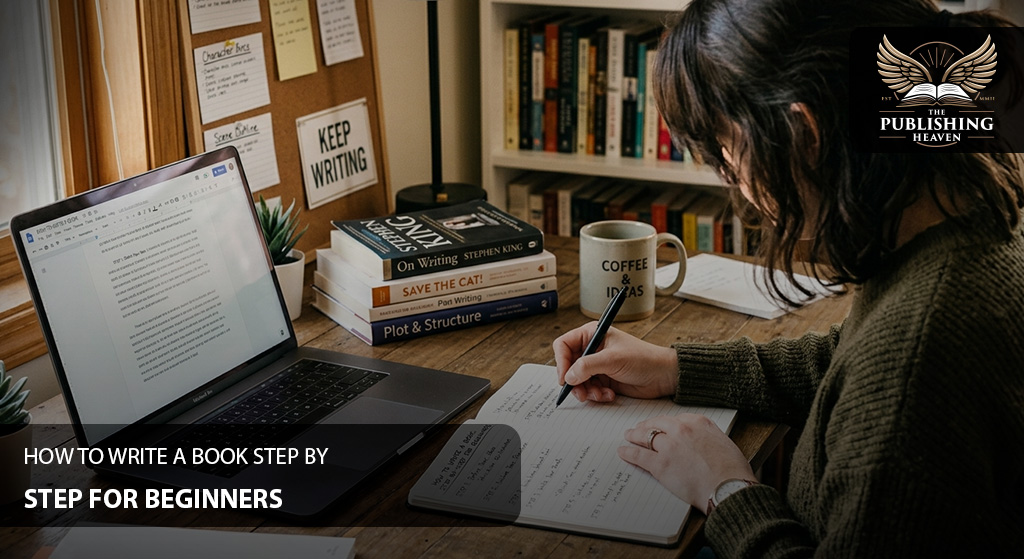
The Dream That Feels Out of Reach
You have a book inside you. Maybe it is a story that has lived in your imagination for years. Maybe it is expertise you want to share with the world. But every time you sit down to write, you freeze. You do not know where to start. The blank page stares back at you.
You are not alone. Thousands of aspiring authors feel the same way. They dream of holding their own book but have no idea how to turn that dream into a manuscript.
Here is the truth: writing a book is not magic. It is a process. A series of small, manageable steps that anyone can follow – even if you have never written more than an email.
This guide gives you a simple, step‑by‑step roadmap to write a book. You will learn how to choose your idea, develop characters or arguments, structure your chapters, and write a first draft – without overwhelm. By the end, you will have a clear plan to finally write the book you have been dreaming about.
Let’s turn your blank page into a finished manuscript.
Why Most Beginners Never Finish a Book
The statistics are sobering. Over 80% of people who start a book never finish it. Why? Not because they lack talent. Because they lack a system.
Three reasons beginners fail:
- No plan. They sit down and hope inspiration strikes. It does not. They get lost after a few chapters.
- Perfectionism. They edit every sentence as they write. They never move forward.
- No accountability. They write when they feel like it. Months pass. The manuscript sits unfinished.
The good news: these problems are solvable. A simple step‑by‑step process replaces confusion with clarity. That is what you will learn here.
Additional statistics to motivate you:
- The average non‑fiction book sells about 250 copies per year. A well‑written book in a good niche can sell thousands.
- Many bestselling authors wrote their first book while working full‑time. Stephen King wrote Carrie while teaching high school.
- You do not need to write fast. You need to write consistently. 250 words a day = 91,000 words a year = a full novel.
The Publishing Heaven insight: We have helped hundreds of beginners become authors. The ones who succeed do not wait for inspiration. They follow a system. So can you.
11 Steps to Write a Book (Even If You’ve Never Written Before)
Step 1: Choose Your Book Idea (And Narrow It)
You do not need a completely original idea. You need a focused one.
Questions to ask yourself:
- What do I know more about than most people? (for non‑fiction)
- What stories do I love to read? (for fiction)
- What problem can I solve for readers?
Narrow your scope. A book about “everything about leadership” is too broad. A book about “three habits that make new managers effective” is focused. Focused books are easier to write and sell better.
How to test your idea: Search Amazon for your topic. Are there other books? If yes, good – there is a market. Read their reviews. See what readers loved and what they complained about. Use that feedback to make your book better.
Actionable step: Write down three potential book ideas. Choose the one that excites you most. Then write a one‑sentence summary: “My book is about [specific topic] and will help readers [specific result].”
Step 2: Know Your Audience (Before You Write)
Many beginners write for “everyone.” That is a mistake. If you write for everyone, you connect with no one.
Define your reader:
- What does your reader struggle with?
- What does your reader want?
- What does your reader already know?
Example: Instead of “my book is for leaders,” try “my book is for first‑time managers who feel overwhelmed and want practical tools to lead their teams.”
Create a reader avatar: Give your ideal reader a name, age, job, and specific problem. Keep this avatar on your desk while you write.
Actionable step: Write a paragraph describing your ideal reader. Keep it on your desk while you write. Ask yourself: “Would this person care about this sentence?”
Step 3: Create a Simple Outline
This is the most important step. An outline is your roadmap. Without it, you will get lost.
A simple outline structure (for non‑fiction):
- Introduction: What problem will you solve? What will the reader learn?
- Chapter 1: First key concept or principle
- Chapter 2: Second key concept or principle
- Chapter 3: Third key concept or principle
- … (as many as you need, typically 8‑12 chapters)
- Conclusion: Summarize the key takeaways and give a call to action
A simple outline structure (for fiction):
- Act 1 (first 25%): Introduce characters, setting, and the central conflict
- Act 2 (middle 50%): Rising action, obstacles, setbacks, and a midpoint twist
- Act 3 (final 25%): Climax, resolution, and tying up loose ends
Outline template you can copy:
| Chapter | Title | Key points / scenes |
| Intro | [title] | Hook, problem statement |
| 1 | [title] | Key point 1, example, takeaway |
| 2 | [title] | Key point 2, example, takeaway |
| … | … | … |
| Conclusion | [title] | Recap, call to action |
Actionable step: Write down the title of each chapter. For non‑fiction, add 2-3 bullet points per chapter. For fiction, write a one‑sentence summary of each scene or chapter. Spend 1-2 weeks on this outline. It will save you months of rewriting.
Step 4: Set a Realistic Writing Schedule
You do not need to quit your job to write a book. You need consistency.
How to calculate your timeline:
- Decide your target word count (e.g., 50,000 for a short novel or business book).
- Decide how many words you can realistically write per day (even 250 words is enough).
- Divide: 50,000 / 250 = 200 days (about 7 months).
Examples of daily word counts:
| Pace | Words per Day | Time for 50,000 words |
| Slow but steady | 250 | 7 months |
| Moderate | 500 | 3.5 months |
| Dedicated | 1,000 | 1.5 months |
| Full‑time sprint | 2,000 | 1 month |
Actionable step: Block 30‑60 minutes on your calendar every day at the same time. Label it “Write.” Treat it as non‑negotiable.
Step 5: Write Your First Draft Without Editing
This is where most beginners get stuck. They write a sentence, delete it, rewrite it, and never move forward.
The rule: Your first draft is allowed to be terrible. Really terrible. That is fine. Editing comes later.
How to write a fast first draft:
- Do not re‑read what you wrote yesterday.
- Do not fix typos or grammar.
- Do not research while you write (mark [bracket] and come back).
- Just get words on the page. Even bad words.
Example of a “bad” first draft sentence:
“He walked into the room and it was a room that had a table and a chair and maybe a window and he felt nervous because something was going to happen.”
After editing later, it becomes:
“He stepped into the sparse room. Table. Chair. A single window. His pulse quickened. Something was coming.”
Actionable step: Set a timer for 25 minutes. Write without stopping. When the timer ends, take a 5‑minute break. Repeat. Do this every day.
Step 6: Use Tools to Stay on Track
You do not need expensive software. You just need a distraction‑free writing environment.
Recommended tools for beginners:
- Microsoft Word or Google Docs – simple and free.
- Scrivener – more advanced, but not necessary.
- FocusWriter – distraction‑free interface.
- Pomodoro timer – app or simple kitchen timer.
Option for low‑tech writers: Use a notebook and pen. Some authors write their first draft by hand. It removes screen distractions entirely.
Actionable step: Close your browser tabs. Turn off your phone notifications. Use a tool that blocks distracting websites if needed.
Step 7: Find Accountability
Writing alone is hard. You need someone to keep you honest.
Where to find accountability:
- Tell a friend your goal and ask them to check in weekly.
- Join a writing group (online or local).
- Use a writing tracker (spreadsheet or app) to log your word count.
- Post your daily word count on social media (a public commitment works).
Actionable step: Tell one person today: “I am writing a book. I will send you my word count every Sunday. Please ask me if I did it.”
Step 8: Push Through the Messy Middle
Every author hits a “messy middle.” Around chapter four or five, you will feel stuck. You will doubt your idea. You will want to quit.
This is normal. Push through.
How to push through:
- Lower your standards. It is okay if the middle sections are rough.
- Skip a difficult section and write a later chapter. Come back.
- Write out of order. If you know a scene near the end, write it now.
- Read something in your genre to get inspired.
- Remember: you cannot edit a blank page. You can only edit words that exist.
The 10‑minute trick: Tell yourself you will write for just 10 minutes. Often, those 10 minutes turn into an hour.
Actionable step: When you feel stuck, write 100 words about anything related to your book. Just keep the momentum.
Step 9: Celebrate (Then Set It Aside)
You finished your first draft. That is a huge achievement. Most people never get this far.
What to do now:
- Take a break. 1‑2 weeks. Do not look at your manuscript.
- Celebrate. Buy yourself something small. Tell a friend.
Why the break matters: Distance gives you perspective. When you return, you will see problems you missed before. You will also see strengths you did not notice.
Actionable step: Mark the date on your calendar. Do not open your manuscript until that day.
Step 10: Revise and Get Feedback
After your break, read your manuscript as a reader. Mark problem areas. Then revise.
What to revise first (big picture):
- Does the opening hook you?
- Does the structure make sense?
- Are there missing transitions or confusing sections?
- Are there parts that feel boring? Cut them.
- Is the ending satisfying?
Then get feedback. Beta readers are trusted people who read your manuscript and give honest feedback. Ask 3‑5 people who read your genre.
What to ask beta readers:
- Where did you get bored or confused?
- Did anything feel unbelievable or illogical?
- Would you recommend this book to a friend?
Actionable step: Write a list of 5 people you will ask to read your draft. Tell them you need honest feedback, not praise.
Step 11: Decide What Comes Next (Self‑Edit, Hire an Editor, or Publish)
After revising based on beta feedback, you have three options:
Option A: Self‑edit further. Go through the manuscript line by line. Fix awkward sentences, cut redundancy, tighten prose. Budget 2‑4 weeks.
Option B: Hire a professional editor. This is the recommended path for most beginners. A copyeditor will catch grammar errors; a line editor will improve flow; a developmental editor will fix structure. Cost $1,000‑$5,000, depending on level.
Option C: Publish (if you are confident). If your genre allows for a less polished style (e.g., some non‑fiction, memoir), and you have done multiple revision passes, you can proceed to formatting and publishing.
Actionable step: Decide your budget and timeline. Contact 2‑3 editors for sample edits if you choose Option B.
Expert Insights: 6 Writing Mistakes Beginners Make (And How to Avoid Them)
Mistake 1: Starting Without an Outline
You sit down with a blank page and hope inspiration strikes. Around chapter three, you have no idea where to go.
Fix: Spend 1‑2 weeks on an outline. It saves months of rewriting.
Mistake 2: Editing While You Write
You polish every sentence before moving forward. You never finish.
Fix: Write the entire first draft without looking back. Editing comes later.
Mistake 3: Waiting for Inspiration
You only write when you “feel like it.” That happens rarely.
Fix: Write on a schedule, regardless of inspiration. Discipline beats motivation.
Mistake 4: Writing for Everyone
Your book tries to appeal to every reader. It ends up appealing to no one.
Fix: Define your specific reader before you write. Write to that one person.
Mistake 5: Giving Up at the Messy Middle
Every author hits a difficult patch. Many interpret difficulty as a sign they should quit.
Fix: Expect the messy middle. Keep writing. It gets better.
Mistake 6: Not Getting Feedback
You finish your draft and call it done. You never let anyone else read it.
Fix: Beta readers catch blind spots. Hire a professional editor if you can. Your book will be better.
Examples / Use Cases: Real Beginners Who Wrote Their First Book
Use Case 1: The Busy Parent Who Wrote 250 Words a Day
Before: Maria worked full‑time and had two young children. She thought she had no time to write a book.
What she did: She committed to 250 words per day – about 15 minutes during her lunch break. She wrote consistently for 10 months.
After: She finished a 75,000‑word novel. She says, “I did not believe I could do it until I stopped waiting for big chunks of time.”
Use Case 2: The First‑Time Non‑Fiction Author Who Used an Outline
Before: Tom wanted to write a leadership book. He had great ideas but no structure. He started writing randomly and got lost.
What he did: He spent two weeks creating a chapter‑by‑chapter outline with bullet points. Then he wrote one chapter per week.
After: He finished a 50,000‑word manuscript in four months. He says, “The outline was the key. I never wondered what to write next.”
Use Case 3: The Author Who Hired a Ghostwriter
Before: Lisa had a powerful memoir idea but hated writing. She tried for a year and wrote only 5,000 words.
What she did: She hired a ghostwriter through The Publishing Heaven. She provided interviews and notes. The ghostwriter wrote the manuscript in four months.
After: Her memoir was published and sold 2,000 copies. She says, “I wanted the book, not the process. Ghostwriting was worth every dollar.”
Use Case 4: The Author Who Finished by Lowering Standards
Before: David was a perfectionist. He rewrote the first chapter 15 times. He never reached chapter two.
What he did: He forced himself to write 500 words a day without looking back. He wrote terrible prose – and kept going.
After: He finished a 60,000‑word first draft in 4 months. He says, “Giving myself permission to be bad was the only way I finished.”
Conclusion: Your Book Starts with One Word
Writing a book is not a mystery. It is a sequence of steps:
- Choose a focused idea.
- Know your audience.
- Create a simple outline.
- Set a realistic writing schedule.
- Write the first draft without editing.
- Use tools to minimize distractions.
- Find accountability.
- Push through the messy middle.
- Celebrate and set the draft aside.
- Revise and get feedback.
- Decide on self‑editing, hiring an editor, or publishing.
You do not need to be a born writer. You need to follow a system. The beginners who finish their books are not the most talented. They are the ones who show up consistently.
Your book will not write itself. But with this roadmap, you can. Start today. Write one sentence. Then another. Before you know it, you will have a finished manuscript in your hands.
FAQs: Writing a Book Step by Step for Beginners
Q: How long does it take a beginner to write a book?
For a 50,000‑word book, plan 3‑7 months writing at a consistent pace of 250‑500 words per day. Your first draft takes most of the time; revising and editing adds 1‑3 months.
Q: Do I need to outline every chapter?
Not every scene, but you should know the major beats. A simple outline with chapter titles and a few bullet points per chapter is enough.
Q: What if I get stuck and cannot write?
Lower your goal. Write 50 words instead of 500. Skip the difficult section and write a later chapter. Read something in your genre for inspiration. But do not stop.
Q: Can I write a book if English is not my first language?
Yes. Many successful authors are non‑native speakers. Write your draft, then hire a professional editor to polish the language (cost $1,000‑$3,000).
Q: How do I know if my book idea is good enough?
Search Amazon for similar books. If there are many, there is a market. Read reviews to see what readers want. If there are none, either you found a gap, or there is no demand. Ask potential readers directly.
Q: Does The Publishing Heaven help beginners write their books?
Yes. The Publishing Heaven offers ghostwriting, editing, and coaching services for first‑time authors. Whether you need a writer, an editor, or a complete publishing package, we guide you through every step. Contact us for a consultation.
Strong Call-to-Action (CTA)
You now have a clear, step‑by‑step process to write your book. But knowing the steps is not enough. You need to take action – and sometimes you need help.
At The Publishing Heaven, we support beginners at every stage. If you want to write your own book, we offer professional editing and coaching. If you prefer to focus on your expertise while we handle the writing, our ghostwriting services deliver a polished manuscript. We are a premium, one‑stop publishing solutions company.
Do not let your book stay inside your head. Let us help you bring it into the world.
Ready to write your book?
Visit The Publishing Heaven today to schedule your free consultation. Let’s turn your idea into a finished manuscript – together.
