
You have written a book, or you are thinking about writing one, and you have heard this magical term “self‑publishing” floating around like a fairy godmother who promises to turn your manuscript into a bestseller without any of that nasty rejection letter business.
You picture yourself clicking a few buttons on Amazon, and then, poof, your book appears on digital shelves next to the latest thriller from that author whose name you cannot pronounce. Royalties start trickling into your bank account like a gentle stream, and you spend your days signing copies at events where adoring fans ask for your autograph.
Then you actually look into it, and suddenly you are drowning in acronyms. KDP, ISBN, POD, ACX. You hear terms like “trim size,” “bleed,” and “metadata,” and none of them mean what you think they mean. You start wondering if you accidentally signed up for a medical procedure instead of a publishing platform.
Take deep breaths. We are here to explain what self-publishing is and how it works without the jargon, without the judgment, and with a healthy dose of sarcasm because, honestly, the publishing industry takes itself way too seriously.
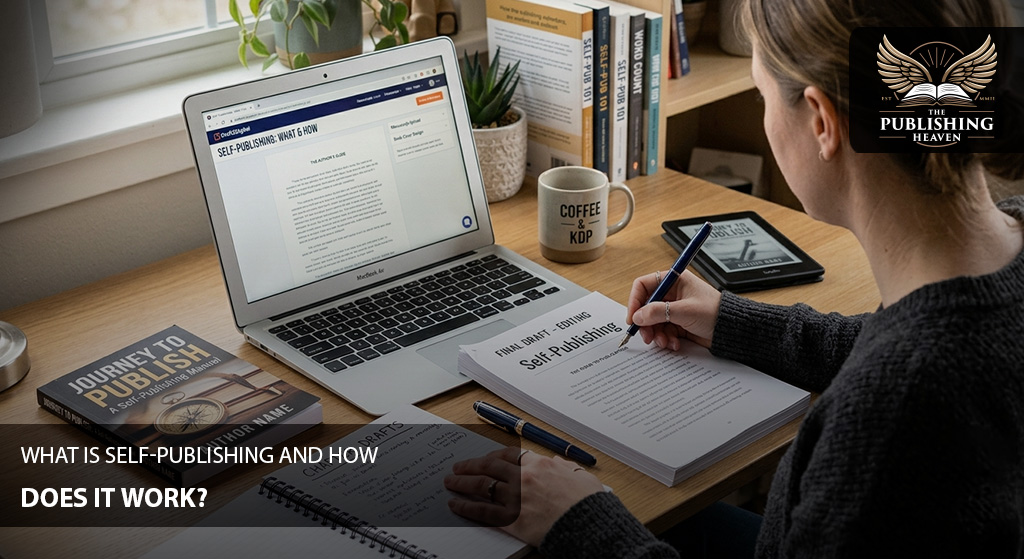
Self-publishing, explained in the simplest possible terms, is this: you, the author, take on the role of the publisher. You do not wait for a big New York publishing house to discover you. You do not send query letters to agents who may or may not read them between smoothie breaks. You take your finished manuscript, and you publish it yourself, usually through platforms like Amazon KDP, Apple Books, or Barnes & Noble Press.
That is the short version. The longer version involves a few more steps, a few more decisions, and hopefully a lot less weeping into your keyboard.
The Traditional Publishing Nightmare
Before we explain how self-publishing works, let me remind you why you are even considering it. Traditional publishing, the old‑school way, is a grind. You write a book. You find a literary agent. You send query letters. You wait.
You wait some more. You receive a form rejection that says, “not right for us at this time.” You cry into your pillow. You revise and repeat incessantly.
If you are lucky enough to land an agent, that agent then submits your book to publishers. You wait again. Months pass. The publisher finally says yes, and you celebrate with champagne. Then they tell you your book will come out in about eighteen months. Eighteen months! You could gestate a whole human baby in that time, and that baby would probably have fewer opinions about your chapter breaks.
The question of self-publishing vs. traditional publishing is really a question of control versus convenience. Traditional publishing gives you a team, an advance, and distribution to physical bookstores, but it takes forever, eats your royalties, and strips away most of your creative decisions. Self-publishing gives you speed, freedom, and up to seventy percent of your eBook sales, but it also gives you the responsibility of doing everything yourself.
For many authors, especially first‑timers who just want their book to exist before the next presidential election, self-publishing is the obvious choice. It is not an easy choice, but it is the fastest and most independent one.
The Step‑by‑Step Journey of a Self‑Published Book
Let me walk you through how to self-publish a book step by step, from your final manuscript to your book living on Amazon, where strangers can buy it and maybe even leave a review that does not mention their dog.
The First Step: Write Your Book
You would be surprised how many people ask about self-publishing before they have actually finished writing. Finish the book first. Do not worry about formatting, covers, or ISBNs yet. Just get the words down.
The Second Step: Edit Your Book
This is where most new authors trip and fall flat on their faces. You cannot edit your own book. You are too close to it. Hire a professional editor. A copyeditor will fix your grammar and consistency. A developmental editor will fix your structure and pacing. A proofreader will catch the typos that everyone else missed. Yes, it costs money. No, you cannot skip it unless you enjoy two‑star reviews that say “great story but full of errors.”
The Third Step: Book Cover Design
Design a cover that does not embarrass you. Readers judge books by their covers. They always have, and they always will, no matter how many times well‑meaning writing groups tell you otherwise. Your cover is your first impression, your handshake, your dating profile photo. Do not design it yourself unless you are a professional designer. Do not ask your nephew who is “good with computers.” Hire a professional cover designer who understands your genre.
The Fourth Step: Format Your Manuscript
This means turning your Word document into a proper eBook file and a print‑ready PDF. eBooks need to reflow on different devices. Paperbacks need consistent margins, page numbers, and a spine that lines up correctly. You can use formatting software, or you can hire a formatter. Please do not just upload a Word document to KDP and hope for the best.
The Fifth Step: Choose Your Platforms
The big one is Amazon KDP.
What is Amazon KDP? It stands for Kindle Direct Publishing, Amazon’s self‑service platform where you upload your book and they list it for sale. KDP handles printing, shipping, customer service, and royalty payments. It is free to use, and it reaches millions of readers. You would be silly not to use it.
But do not stop at Amazon. Self-publishing platforms explained include Barnes & Noble Press, Kobo Writing Life, Apple Books, and Google Play. You can also use an aggregator like Draft2Digital or IngramSpark to distribute your book to multiple stores at once. More stores, more chances for readers to find you.
The Sixth Step: Get an ISBN
An International Standard Book Number is the unique barcode that identifies your book. You can get a free one from Amazon, but it lists Amazon as the publisher, not you. Buy your own from Bowker. It costs $125 for a single ISBN or $295 for ten. Buy the pack. You will write more books.
The Seventh Step: Set Your Price And Publish
You upload your files, write a compelling book description (no pressure), choose your categories and keywords, and click publish. Within 72 hours, your book is live. You refresh the page obsessively, waiting for the first sale. It is terrifying and exhilarating all at once.
The Eighth Step: Market Your Book
This is the part nobody warns you about. Publishing is not the finish line. It is the starting line. You need to tell people your book exists. You need reviews, ads, social media, email lists, and probably a small miracle. But that is a whole other guide.
How Much Does Self-Publishing Cost?
Here is the question everyone asks, usually while clutching their wallets protectively. How much does self-publishing cost?
Let’s talk numbers. The answer is that it costs whatever you want it to cost, but if you want a professional book that does not scream “I published this from my mom’s basement,” you should budget for a few things.
Professional editing: $500 to $2,000, depending on the level of editing. Professional cover design: $200 to $800. Formatting: $50-$300 if you hire someone, or $200 for software if you do it yourself. ISBN: $125. Total: $875 to $3,225.
You can do it for less. You can edit your own book (bad idea), design your own cover (worse idea), and skip the ISBN (short‑sighted idea). But every corner you cut will show.
Readers will notice.
Is self-publishing worth it when you add up the costs and the work? For most authors, yes. You keep your rights, your royalties, and your creative control. You move fast. You learn the business. And when you sell your first copy to a stranger who does not share your last name, it feels amazing.
Self-Publishing vs Traditional Publishing vs Vanity Publishing
While we are here, let’s clear up a few confusions.
The difference between self-publishing and traditional publishing is fairly straightforward.
1. Self-Publishing
With self-publishing, you manage the process yourself, maintain creative control, and keep a larger share of the royalties.
2. Tradtional Publishing
With traditional publishing, the publisher handles much of the production, distribution, and bookstore placement, often providing an advance payment in return for a significant share of the profits and publishing rights.
3. Vanity Publishing
Vanity presses are companies that charge you thousands of dollars to print your book and maybe put it on Amazon. They are not selective. They will publish anyone with a credit card. They often keep the rights. They are not the same as self-publishing, where you control everything. Avoid vanity presses. They are the timeshares of the publishing world.
Self-publishing vs hybrid publishing is a newer category. Hybrid publishers charge fees but offer professional services and distribution. Some are legitimate. Some are just vanity presses with better marketing. Do your research.
Is self-publishing legitimate? Absolutely. Bestsellers like The Martian, Fifty Shades of Grey, and The Shack all started as self‑published books. It is not a scam. It is not cheating. It is just a different path.
How Long Does Self-Publishing Take?
Here is some good news. From the moment you upload your files to the moment your book is live, how long does self-publishing usually take, 24 to 72 hours? That is the fast part.
The slow part is everything before that. Writing, editing, designing, formatting. Most first‑time authors take three to six months from finished manuscript to published book, assuming they are not rushing. If you are rushing, you are probably skipping important steps. Do not rush.
How to self-publish a book and actually sell copies takes even longer because marketing is a marathon. The book launch is just the first mile.
The Beautiful Chaos of Being a Self-Published Author
Here is what nobody tells you about self-publishing your own book. It is liberating and terrifying in equal measure.
You have total control. You choose the cover, price, release date, and categories. You are not waiting for anyone’s permission. That freedom is intoxicating.
But you also have total responsibility. If the editing is sloppy, that is on you. If the cover is ugly, that is on you. If the book does not sell, that is on you. No publisher to blame, no agent to fire. Just you and your decisions.
Self-publishing for first-time authors is a crash course in everything from project management to marketing psychology. You will learn skills you never knew you needed. You will make mistakes. You will fix them. You will grow.
And when you hold that first physical copy in your hands, the one with your name on the cover, the one that arrived in a box from Amazon because you ordered your own book just to see it, you will feel a sense of accomplishment that no traditional publishing deal could ever replicate.
What Successful Self-Published Authors Know?
The authors who succeed in self-publishing treat it like a business. They invest in professional editing, cover design, and formatting. They learn marketing. They write series, because the best marketing for your first book is your second book. They are patient. They do not expect overnight success.
How authors make money self-publishing is not about hitting the bestseller list. It is about building a backlist of books that sell steadily over time. One book might earn you pocket change. Ten books can earn you a living.
Self-publishing royalties on Amazon are generous: 70% for eBooks priced $2.99 to $9.99, and 60% for paperbacks, minus printing costs. That is much higher than traditional publishing royalties, which are often 10% to 25%.
Indie author publishing guide tip: Do not compare your beginning to someone else’s middle. The successful self-published authors you admire have been at this for years. They failed upward.
You will too.
Frequently Asked Questions (FAQs)
What is self-publishing, and how does it work for beginners?
Self-publishing means you publish your book yourself using platforms like Amazon KDP. You handle or pay for editing, cover design, formatting, and marketing. The platform handles printing, distribution, and royalties.
How does Amazon self-publishing work?
You create a KDP account, upload your manuscript and cover, set your price, and click publish. Amazon makes your book available on their store, prints copies on demand, and pays you royalties every month.
How much does it cost to self-publish a book?
You can do it for free using only free tools, but a professional book typically costs $900 to $3,000 for editing, cover design, formatting, and ISBN.
Is self-publishing worth it for first-time authors?
Yes, if you want to get your book out quickly, keep creative control, and earn higher royalties. No, if you dream of seeing your book in physical bookstores without doing the legwork yourself.
Do I need an ISBN for self-publishing?
Not if you use Amazon’s free ISBN, but then Amazon is listed as the publisher. For professional credibility and ownership, buy your own ISBN.
Can you make money self-publishing books on Amazon?
Yes, many authors do. But it takes time, multiple books, and consistent marketing. One book is rarely enough to replace a full‑time income.
How long does self-publishing take from start to finish?
Writing aside, the publishing process (editing, design, formatting, upload) takes one to three months. The actual upload to live takes 24 to 72 hours.
How does The Publishing Heaven help with self-publishing?
We offer professional self-publishing services, including editing, cover design, formatting, ISBN registration, and distribution. Our packages take you from manuscript to published book. One hundred percent ownership. No hidden fees.
Conclusion
Explained self-publishing is not nearly as scary as the acronyms make it seem. You write a book, you polish it until it shines, you hire professionals for the parts you cannot do yourself, and you upload it to platforms where readers can buy it. That is the core of it. Everything else is details.
How self-publishing works is a process, not a mystery. You learn the steps. You take them one at a time. You make mistakes, and you fix them. Eventually, you hold a book with your name on it, and you realize that all the confusion was worth it.
At The Publishing Heaven, we help authors navigate the chaos of self-publishing without losing their minds. We offer editing, cover design, formatting, ISBN registration, distribution, and even ghostwriting, if needed. You focus on your story. We focus on making it look professional.
Our packages:
- Basic Package ($299): Writing assistance, editing, proofreading, typesetting, formatting, Amazon and Kindle publication, eBook, paperback, hardcover.
- Silver Package ($599): Everything in Basic, plus Barnes & Noble, Kobo, Lulu, Goodreads, Books a Million publication, custom cover design, author website with one-year free domain and hosting.
- Gold Package ($999): Everything in Silver, plus ISBN and barcode, audiobook, video trailer, and press release distribution across 250-plus platforms.
One hundred percent ownership. No hidden fees. No confusing acronyms are explained in the text; they are only explained in footnotes.
Ready to stop asking “what is self-publishing” and start doing it? Visit The Publishing Heaven today and schedule your free consultation. Your book wants to be free. Let us help you set it loose.
