
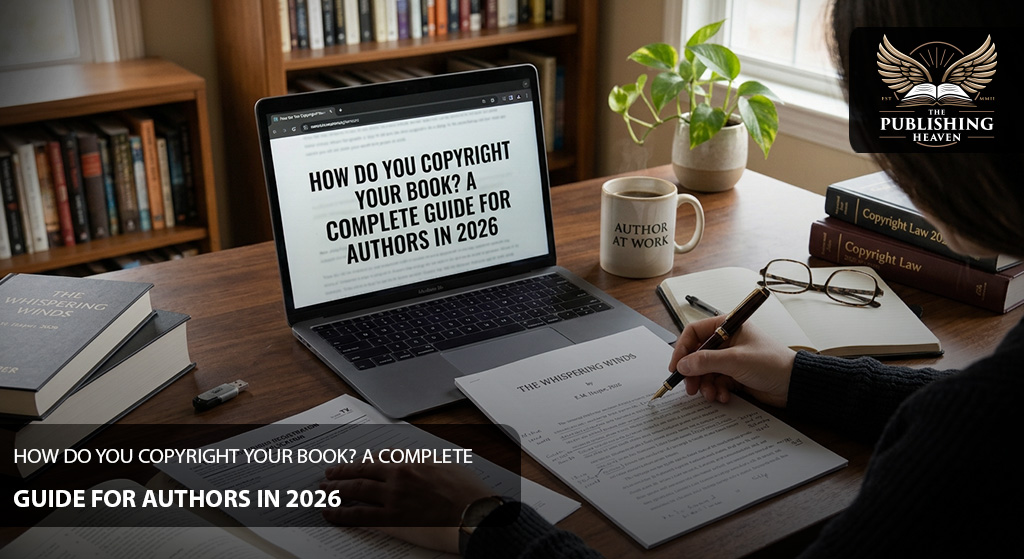
If you’re wondering how do you copyright your book, understanding the registration process is essential for protecting your creative work. Copyright gives authors important legal rights over their original writing. Moreover, it helps them control reproduction, distribution, and certain uses of their manuscripts.
In the United States, copyright protection generally begins automatically when an author creates and records an original work. However, registering that work offers additional legal advantages. Therefore, authors should understand the difference between copyright ownership and official registration.
Many first-time writers mistakenly believe they must publish their books before obtaining copyright protection. Others assume purchasing an ISBN automatically protects their intellectual property. Neither assumption accurately describes how copyright works.
Fortunately, the registration process is relatively straightforward when authors understand the requirements.
This guide explains copyright ownership, registration costs, application procedures, and common mistakes. Additionally, it explores how authors can protect their manuscripts throughout the publishing process.
The registration guidance and fees below primarily concern United States copyright law. Requirements may differ in other countries.
Table of Contents
- What Is Book Copyright and Why Does It Matter?
- How Do You Copyright Your Book?
- Ten Essential Steps for Copyrighting Your Book
- How Much Does It Cost to Copyright a Book?
- Copyright Registration Before and After Publishing
- Copyright vs. ISBN: Understanding the Difference
- How to Protect Your Book From Copyright Infringement
- Professional Publishing Services and Copyright Assistance
- Common Copyright Registration Mistakes
- Frequently Asked Questions
- Conclusion
What Is Book Copyright and Why Does It Matter?
Copyright is a legal protection for original creative expression. For authors, it covers qualifying written material, including novels, memoirs, poetry, and nonfiction books.
According to the United States Copyright Office, copyright generally exists automatically once original work appears in a fixed form.
For example, writing a novel in a computer document can establish copyright protection. Similarly, handwritten manuscripts can qualify when they contain original creative expression.
However, copyright does not protect general ideas, facts, or concepts themselves. Instead, it protects an author’s particular creative expression of those ideas.
Why Copyright Protection Is Important for Authors
Copyright grants qualifying owners exclusive rights over specific uses of their work.
These rights generally include reproducing the manuscript, distributing copies, and preparing derivative works.
Moreover, copyright owners can authorize other parties to use their material through licensing agreements.
Registration offers additional advantages under United States law. Consequently, authors may have stronger options when addressing unauthorized uses.
For United States works, registration or refusal generally precedes an infringement lawsuit. Timely registration can also support eligibility for certain statutory damages and attorney fees.
Therefore, understanding registration requirements helps authors prepare for potential intellectual property disputes.
How Do You Copyright Your Book?
Learning how do you copyright your book involves understanding both automatic protection and optional registration.
In the United States, authors generally obtain copyright automatically when they create and fix original writing. However, official registration establishes a public record and provides additional legal benefits.
The registration process involves several important actions.
Step 1: Complete Your Original Manuscript
Begin by preparing the written material you want to register.
Although you can register an unpublished book, the manuscript should represent the work covered by your application.
Additionally, review the document for significant omissions and unresolved structural issues.
Substantial later revisions may contain new copyrightable material beyond the original registration.
Step 2: Confirm Copyright Ownership
Next, determine who legally owns the manuscript’s copyright.
An author generally owns copyright in their original writing. However, employment arrangements, joint authorship, and written agreements can affect ownership.
For example, ghostwriting contracts should explain copyright ownership and any agreed transfer of rights.
Therefore, authors should review relevant agreements before submitting a registration application.
Step 3: Visit the Official Copyright Registration Website
United States authors can begin through the U.S. Copyright Office registration portal.
The website provides information about literary works, registration forms, deposits, and applicable fees.
Additionally, authors can access online filing instructions and official guidance.
Avoid assuming that third-party registration services represent the government. Instead, confirm the registration destination before entering personal or payment information.
Step 4: Select the Appropriate Registration Application
Books generally fall within the literary works category.
However, the appropriate application depends on authorship, ownership, and other eligibility requirements.
For instance, the Single Application has stricter requirements than the Standard Application.
Consequently, writers should review each option before selecting a form.
Step 5: Enter Accurate Book Information
The application requests information about the work and its authorship.
Authors may need to provide the book title, author details, claimant information, and publication status.
Additionally, the form may require disclosure of previously published or excluded material.
Check every entry carefully before submitting the application.
Step 6: Submit the Required Manuscript Copy
Copyright registration generally requires a deposit copy of the work.
For certain applications, authors can upload acceptable electronic files. However, published print editions may require physical copies.
Therefore, follow the instructions associated with your particular manuscript and publication status.
Step 7: Pay the Registration Fee
Complete the payment using the official registration system.
The amount depends on the application category and filing method.
Moreover, copyright registration fees are generally separate from publishing, editing, or ISBN expenses.
Step 8: Retain Your Submission Records
After submitting the application, preserve the confirmation information and payment receipt.
Additionally, keep copies of your manuscript and related correspondence.
These materials can help you monitor the registration process and maintain organized publishing records.
Step 9: Respond to Copyright Office Requests
The Copyright Office may request clarification or additional information.
Therefore, monitor the contact method associated with your application.
Respond carefully to official requests and provide accurate supporting information when necessary.
Step 10: Preserve Your Registration Certificate
If the Copyright Office approves your application, it issues a registration certificate.
Keep the certificate with your important publishing documents.
However, remember that the registration covers the authorship identified in the approved claim.
Ten Essential Steps for Copyrighting Your Book
The following table summarizes the registration process for authors preparing United States copyright applications.
| No. | Copyright Registration Step | Important Requirement |
| 1 | Prepare your manuscript | Identify the original work you want to register |
| 2 | Verify ownership | Confirm authorship and contractual rights |
| 3 | Access the official portal | Use the U.S. Copyright Office website |
| 4 | Choose an application | Select the appropriate literary registration form |
| 5 | Provide book information | Enter accurate title and authorship details |
| 6 | Prepare deposit materials | Follow the applicable submission requirements |
| 7 | Pay the filing fee | Confirm the current official registration cost |
| 8 | Save submission records | Preserve receipts and application information |
| 9 | Monitor the application | Respond to requests for clarification |
| 10 | Keep the certificate | Maintain proof of approved registration |
These steps provide a practical overview. However, individual applications may involve additional requirements based on publication and ownership circumstances.
How Much Does It Cost to Copyright a Book?
Copyright protection itself does not require purchasing a registration.
However, authors who choose official United States registration must pay the applicable filing fee.
The U.S. Copyright Office fee schedule lists the following registration charges.
| Registration Method | Official Fee |
| Single Application, eligible online filing | $45 |
| Standard Application, online filing | $65 |
| Standard paper application | $125 |
These are government filing fees, not charges for professional publishing assistance.
Understanding the Single Application
The Single Application serves eligible authors registering one work.
The author must be one individual who owns the entire work. Additionally, the work cannot qualify as work made for hire.
Other eligibility restrictions also apply.
Therefore, not every author can use the lowest-priced application.
Understanding the Standard Application
The Standard Application accommodates a broader range of registration circumstances.
For example, it can cover certain jointly authored works and more complicated ownership arrangements.
Consequently, authors should evaluate eligibility rather than automatically selecting the cheapest filing option.
Are Additional Copyright Expenses Necessary?
Authors may choose professional assistance with documentation or related publishing tasks.
However, hiring a third-party company is not a requirement for ordinary copyright registration.
Additionally, copyright registration does not automatically include editing, formatting, printing, or distribution.
Keeping these expenses separate helps prevent unnecessary confusion.
Copyright Registration Before and After Publishing
Authors frequently ask whether copyright registration should happen before publication.
Fortunately, United States law generally allows registration of eligible published and unpublished works.
However, publication status can affect application details, deposit requirements, and certain legal remedies.
Copyrighting an Unpublished Manuscript
An unpublished manuscript can qualify for copyright protection once its original expression exists in a fixed form.
Therefore, authors do not need to release their books publicly before obtaining protection.
Additionally, eligible unpublished works can undergo official registration.
This option may appeal to writers preparing their manuscripts for future publication.
Copyrighting a Published Book
Authors can also register books after publication.
However, registration timing matters when determining eligibility for certain legal remedies.
For example, United States law provides important timing rules involving statutory damages and attorney fees.
Consequently, authors should investigate registration before publication or shortly afterward.
Understanding Deposit Requirements
Some published works require physical deposit copies.
Additionally, United States mandatory deposit rules can create separate obligations for certain published works.
The Copyright Office’s mandatory deposit guidance explains these requirements and applicable exceptions.
Therefore, authors should not assume electronic registration always satisfies every deposit requirement.
Copyright vs. ISBN: Understanding the Difference
Many first-time authors confuse copyright registration with ISBN registration.
However, these systems serve entirely different purposes.
What Does Copyright Protect?
Copyright protects qualifying original creative expression.
For example, it can protect a novel’s written narrative, dialogue, and other original literary elements.
Additionally, copyright gives the owner certain exclusive rights concerning the work’s use.
What Does an ISBN Do?
An International Standard Book Number identifies a particular book edition or format.
For instance, paperback and hardcover editions generally require separate ISBNs when identifiers are needed.
However, an ISBN does not establish copyright ownership or replace official registration.
Consequently, obtaining an ISBN should not be confused with protecting intellectual property.
Do Self-Published Authors Need Both?
Authors may benefit from copyright registration and ISBN identification for different reasons.
Copyright registration concerns legal rights and their enforcement. Meanwhile, ISBNs support book identification and distribution.
For additional publishing guidance, authors can consult the official Amazon Kindle Direct Publishing Help Center.
Additionally, professional book publishing services may help authors understand manuscript preparation and publication requirements.
How to Protect Your Book From Copyright Infringement
Registration represents one important step in protecting a manuscript.
However, authors should also maintain clear documentation and understand their rights.
Keep Original Writing Records
Preserve manuscript drafts, research notes, and dated working files.
Additionally, maintain records of important editorial revisions and publishing agreements.
These documents can help establish the development history of your work.
However, personal records do not replace the legal benefits of official registration.
Include a Copyright Notice
Authors can include a copyright notice within the book’s front matter.
A standard notice generally identifies the copyright symbol, publication year, and copyright owner’s name.
For example, an author might include a statement identifying the year and their legal name.
However, United States copyright protection generally does not depend on including a notice.
A properly presented notice can still communicate ownership information to readers.
Use Written Agreements With Professionals
Authors sometimes collaborate with ghostwriters, editors, illustrators, and designers.
Therefore, written agreements should clearly define ownership and permitted uses of contributed material.
Moreover, authors should determine whether licenses or copyright assignments are necessary.
For example, hiring a cover designer does not automatically transfer every copyright interest in the artwork.
Consequently, contracts deserve careful attention before publication.
Monitor Unauthorized Use
Occasionally, authors may encounter unauthorized copies or suspicious reproductions of their books.
Therefore, periodically check relevant online bookstores and distribution platforms.
If infringement occurs, preserve evidence and review the available reporting procedures.
Additionally, consider qualified legal advice when ownership or enforcement questions become complicated.
Understand Copyright and AI-Generated Material
Authors increasingly use artificial intelligence during writing and publishing.
However, AI-generated material raises additional copyright registration considerations.
The United States Copyright Office explains that copyright protection depends on sufficient human authorship.
Consequently, applicants may need to identify human-created contributions and disclose certain AI-generated material.
Authors can review the official Copyright and Artificial Intelligence guidance for detailed information.
Professional Publishing Services and Copyright Assistance
Authors often need additional support after completing their manuscripts.
However, copyright registration and professional publishing services should remain clearly distinguished.
The following companies offer publishing-related services that authors can investigate when preparing their books.
The Publishing Heaven offers services connected with manuscript development, editing, formatting, and book publication.
Therefore, authors can explore professional assistance during different stages of their publishing projects.
Additionally, writers should confirm whether a particular package includes administrative copyright assistance or only publishing preparation.
Official United States copyright registration remains the responsibility of the applicant and the Copyright Office.
360 Book Marketeers is a company authors can consider when exploring book marketing and promotion.
After preparing a manuscript for publication, authors often need strategies for reaching potential readers.
Therefore, understanding available marketing services can support broader publishing plans.
However, promotional assistance should not be mistaken for government copyright registration.
Global Book Distributors is another option to investigate for book distribution and related publishing assistance.
Authors should understand distribution arrangements before making their books available through additional channels.
Moreover, distribution agreements may contain important licensing and ownership provisions.
Consequently, reviewing these terms helps authors make informed decisions about their intellectual property.
KDP Publishing Team is another company authors may consider when comparing independent publishing assistance.
However, writers should confirm the provider’s specific services, pricing, and contractual terms.
Additionally, remember that independent publishing companies are not automatically affiliated with Amazon Kindle Direct Publishing.
Copyright registration should always follow the relevant government’s official procedures.
Common Copyright Registration Mistakes Authors Should Avoid
Copyright registration is easier when authors understand the requirements beforehand.
However, several misconceptions can create unnecessary problems.
Believing Copyright Begins Only After Registration
Some writers assume their manuscripts receive no protection before registration.
However, original writing generally receives automatic United States copyright protection once fixed in a tangible medium.
Registration provides additional legal advantages rather than creating every underlying copyright right.
Confusing Copyright With Publishing Rights
Copyright ownership and publishing agreements are related but distinct matters.
For example, an author might license certain publication rights without transferring complete copyright ownership.
Therefore, examine agreements carefully before granting rights to another party.
Registering Under Incorrect Ownership Information
Inaccurate ownership details can complicate copyright registration.
Consequently, confirm the correct author, claimant, and contractual relationships before applying.
Seek professional guidance when joint authorship or ownership transfers create uncertainty.
Assuming Book Titles Receive Copyright Protection
Copyright generally does not protect individual titles, names, or short phrases.
However, some names or titles may raise separate trademark issues under applicable circumstances.
Therefore, authors should understand the distinction between copyright and trademark protection.
Ignoring Copyright Requirements for Illustrations
Books may contain material created by several contributors.
For example, an illustrator might retain rights to artwork unless an agreement provides otherwise.
Consequently, writers should verify ownership or licensing rights before including third-party creative materials.
Using Unofficial Registration Websites Without Research
Some commercial websites charge authors for registration-related assistance.
However, only the U.S. Copyright Office handles federal copyright registration.
Therefore, authors should verify services and fees before sharing information or making payments.
Frequently Asked Questions
1. How do you copyright your book for the first time?
Original books generally receive automatic copyright protection in the United States once written and fixed.
However, authors can obtain additional legal benefits through official registration.
Visit the U.S. Copyright Office website, select an appropriate application, submit the required materials, and pay the fee.
2. How much does it cost to copyright a book in 2026?
The U.S. Copyright Office lists $45 for an eligible online Single Application.
Meanwhile, the online Standard Application costs $65, and standard paper filing costs $125.
Therefore, the amount depends on your application type and eligibility.
3. Can I copyright my book before publishing it?
Yes. Eligible unpublished manuscripts can receive copyright registration.
Additionally, automatic protection generally begins before publication once original writing exists in a fixed form.
Consequently, authors do not need to wait until their books become available for sale.
4. Do I need an ISBN to copyright my book?
No. ISBN identification and copyright registration serve different purposes.
An ISBN helps identify book editions. However, it does not establish copyright ownership.
Therefore, authors can register eligible manuscripts without purchasing ISBNs.
5. Can someone steal my book if it is not registered?
Unauthorized copying can occur whether a work is registered or unregistered.
However, original manuscripts generally receive automatic copyright protection under United States law.
Registration provides important additional enforcement benefits, especially when authors meet applicable timing requirements.
6. How long does book copyright protection last?
For most qualifying works created by individual authors today, United States copyright generally lasts for the author’s lifetime plus 70 years.
However, different rules apply to certain joint works, works made for hire, and older publications.
Therefore, the applicable duration depends on the work’s circumstances.
7. Does copyright protect my book internationally?
Copyright protection often extends across countries through international treaties.
However, enforcement procedures, exceptions, and legal remedies differ by jurisdiction.
Consequently, authors should review the rules of countries where specific protection or enforcement becomes necessary.
8. Can I copyright a book written with a ghostwriter?
Yes, qualifying original written material may receive copyright protection.
However, ownership depends on authorship and applicable contracts.
Therefore, clearly establish copyright ownership and any necessary written transfers before registration.
9. Can I copyright a book containing AI-generated text?
A book containing AI-generated material may qualify for protection of its sufficiently original human-authored elements.
However, purely AI-generated expression generally does not qualify for United States copyright protection.
Additionally, applicants must follow relevant disclosure and authorship identification requirements.
10. Do I need a lawyer to copyright my book?
Most authors can complete ordinary United States copyright registration without hiring a lawyer.
However, complex ownership disputes, licensing agreements, and infringement concerns may require professional legal assistance.
Therefore, evaluate your situation before deciding whether legal representation is necessary.
Conclusion
Understanding how do you copyright your book helps authors protect their original writing and make informed publishing decisions. In the United States, copyright generally begins automatically when original creative expression exists in a fixed form. However, official registration provides additional advantages, including important enforcement rights and a public record of ownership.
Before registering, confirm the manuscript’s ownership, select the appropriate application, and review the official fees. Additionally, preserve your writing records and examine agreements with editors, ghostwriters, and other contributors. These precautions can reduce uncertainty while helping protect your creative work.
For authors preparing manuscripts for publication, The Publishing Heaven offers writing, editing, formatting, and publishing-related services. Meanwhile, 360 Book Marketeers provides another company option to investigate for promotional support. Authors can also explore Global Book Distributors and KDP Publishing Team for additional publishing-related assistance.
Nevertheless, professional publishing support does not replace official copyright registration. Authors should follow the relevant legal procedures and verify requirements through authoritative government resources.
Your book represents an investment of creativity, effort, and time. Therefore, understanding copyright protection before publication can help safeguard your work and support your long-term writing goals.
