
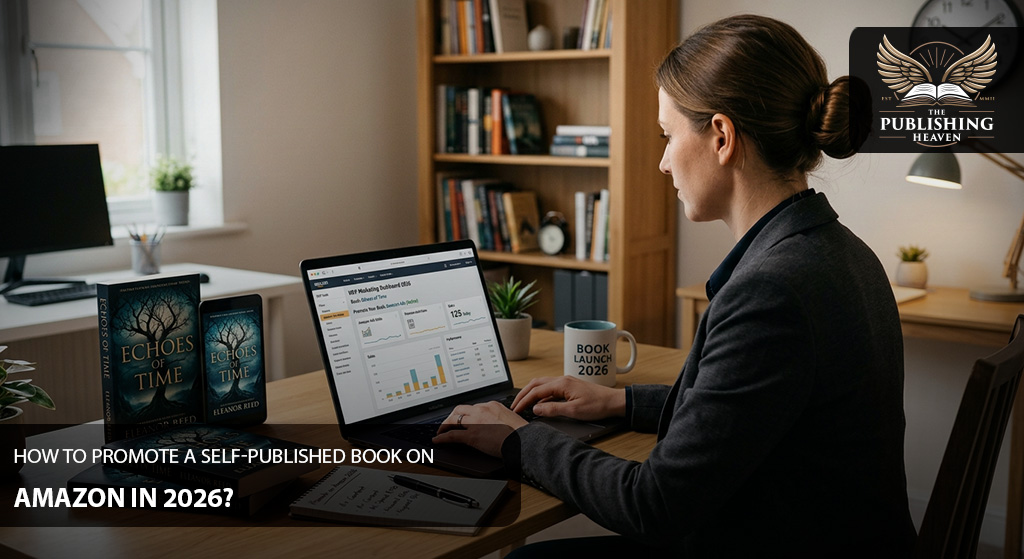
Learning how to promote a self-published book on Amazon can help you reach more readers and build steady sales. However, publishing your book on Amazon does not guarantee that readers will find it. You need a thoughtful promotion strategy that combines strong book metadata, an appealing sales page, Amazon tools, external marketing, and consistent reader outreach.
Amazon gives self-published authors several ways to promote their books. For example, you can use Amazon Author Central, Amazon Ads, A+ Content, keywords, pre-orders, and selected promotional programs. You can also promote your book through your website, email list, social media, and other legitimate marketing channels.
However, promotion should begin before you spend money on advertising. First, make sure your book has a professional cover, strong description, accurate categories, competitive pricing, and a polished product page. Then, choose promotional methods that match your genre, audience, budget, and publishing goals.
Table of Contents
- Why Amazon Book Promotion Matters
- Start With a Strong Amazon Book Page
- Choose the Right Amazon Keywords
- Select Relevant Categories
- Build Your Amazon Author Central Page
- Improve Your Book Description
- Use A+ Content
- Run Amazon Ads
- Start With Sponsored Products
- Promote Your Book Outside Amazon
- Build an Author Website
- Use Email Marketing
- Promote Your Book on Social Media
- Use Your Existing Books to Promote New Releases
- Consider KDP Select Promotions
- Use Pre-Orders Strategically
- Get More Book Reviews the Right Way
- Create a Launch Plan
- Track Your Results
- Common Amazon Book Promotion Mistakes
- When to Hire Professional Book Marketing Help
- Frequently Asked Questions
- Conclusion
Why Amazon Book Promotion Matters
Amazon is more than a place where readers buy books. It is also a search and discovery platform.
Readers often search Amazon by genre, topic, author, series, or keywords. Therefore, your book needs accurate information that helps Amazon understand what it offers and helps readers decide whether it matches their interests.
Amazon states that relevant keywords can improve a book’s placement in Amazon Store search results. The company also considers factors such as sales history and Best Sellers Rank when determining search placement.
However, visibility alone does not guarantee sales. Your book must also persuade readers after they find it.
For example, a strong cover can attract attention. A clear description can explain the story or value. Meanwhile, reviews and a professional author page can help establish credibility.
Therefore, successful promotion involves both discovery and conversion.
Start With a Strong Amazon Book Page
Before promoting your book, improve the Amazon detail page. This page is where interested readers decide whether to continue toward a purchase.
Start with a professional cover that communicates your genre quickly. Then, write a compelling description that explains what makes the book worth reading without giving away too much.
Your title, subtitle, author name, categories, keywords, and description should also create a consistent message. When these elements work together, readers can understand your book more quickly.
Next, check the pricing. Your price should fit your genre and book length while supporting your publishing goals. However, do not choose a price simply because another author uses it.
Consider your audience as well. A debut novelist may need a different strategy from an established author with a large backlist.
Before launching advertising, review the complete Amazon product page. You can also explore The Publishing Heaven’s book marketing services if you want professional assistance with positioning and promotion.
Choose the Right Amazon Keywords
Keywords can help readers find your book when they search Amazon. Therefore, keyword research should form part of your promotion strategy.
Think about the phrases your ideal readers might type into Amazon. For example, a reader searching for a historical romance may use terms related to the setting, period, themes, or romantic tropes.
However, avoid adding unrelated popular terms simply because they receive searches. Amazon recommends using keywords that accurately describe the book and reflect terms customers may use when searching.
You can also examine competing books in your genre. Look at their categories, subtitles, descriptions, and positioning. Then, identify opportunities where your book can compete without copying another author’s metadata.
Most importantly, keep your keywords relevant. Accurate metadata helps attract readers who are more likely to enjoy the book.
Select Relevant Categories
Categories help Amazon place your book within appropriate sections of its store. They can also help readers find books that match their interests.
Choose categories that accurately represent your book. Do not select a category solely because it appears easier to rank in.
For example, placing a psychological thriller in a general mystery category may reach some readers. However, a more precise category can attract people who specifically want psychological thrillers.
Your categories should also match your cover, description, keywords, and actual content. Consistency strengthens your overall positioning.
Furthermore, review your categories periodically. Your book may evolve as your series grows, and Amazon’s available category options can change.
When you update metadata, make sure every change still reflects the book accurately.
Build Your Amazon Author Central Page
Amazon Author Central gives authors an important promotional tool. It allows you to create an Author Page, add books, provide a biography, monitor certain information, and give readers a place to learn more about you.
Therefore, claim your Author Central page as soon as your book becomes eligible.
Start with a professional author biography. Your biography should tell readers who you are, what you write, and what they can expect from your books.
Next, add an appropriate author photograph if available. You should also make sure your books appear correctly on your page.
Amazon also provides an Author Follow feature. Readers can follow authors and may receive notifications about eligible new releases or pre-orders, depending on their settings and Amazon’s eligibility requirements.
Consequently, Author Central can support more than a single book launch. It can help you build a long-term author presence on Amazon.
You can read Amazon’s official Author Central guidance before setting up your page.
Improve Your Book Description
Your book description should sell the reading experience without sounding exaggerated.
For fiction, focus on the central conflict, characters, stakes, setting, and emotional promise. For nonfiction, explain the problem you address, the value you provide, and what readers can expect to learn.
However, avoid turning the description into a long summary. Readers need enough information to become curious, not every detail of the book.
Use short paragraphs and clear formatting. Lead with a strong hook, then develop the central promise.
For example, a thriller description might introduce a dangerous situation before revealing why the protagonist cannot escape. A business book might begin with the problem readers face and then explain how the book approaches it.
Above all, make sure your description matches the actual book. Misleading copy may attract clicks, but it can also create disappointed readers.
Use A+ Content
A+ Content can add another visual layer to your Amazon book detail page. Amazon allows eligible KDP authors to use images, text, and comparison tables to provide more information about their books.
This feature can work especially well for authors with several related books. For example, a series author can use appropriate comparison content to help readers understand the reading order.
You can also use A+ Content to present your author story or highlight elements of your book. However, Amazon has specific rules for this content.
For example, A+ Content cannot include certain promotional language, customer reviews, external web links, or competitor comparisons. Therefore, review the official A+ Content guidelines before creating your page.
A+ Content should support the book rather than overwhelm the reader. Keep the visuals professional, relevant, and consistent with your cover and brand.
Run Amazon Ads
Amazon Ads can put your book in front of readers while they browse the Amazon Store. KDP currently offers advertising options for eligible books, including Sponsored Products and Sponsored Brands.
However, advertising works best when your product page is already strong.
If your cover looks amateurish, your description lacks a hook, or your targeting is too broad, paid traffic may simply produce expensive clicks without enough sales.
Therefore, start with a controlled budget. Test relevant keywords and audiences instead of spending heavily from the beginning.
Sponsored Products can appear in shopping results and on product detail pages. When a reader clicks an ad, Amazon directs them to the book’s detail page.
This setup makes your product page especially important. Your advertisement earns the click, but your book page must help earn the sale.
You can review Amazon’s official KDP advertising guide before launching a campaign.
Start With Sponsored Products
Sponsored Products can be a practical starting point for authors who want to test Amazon advertising.
First, identify keywords and books that closely relate to your target audience. Then, create campaigns around those terms and monitor the results.
For example, a fantasy author might test keywords related to the subgenre, themes, and comparable reading interests. A nonfiction author could focus on problems, subjects, and reader needs.
However, do not assume that every keyword will produce profitable sales. Some keywords may generate many clicks but few purchases.
Therefore, evaluate performance over time. Look at impressions, clicks, spending, sales, and other available campaign data.
Start small, learn what works, and adjust your targeting. This approach gives you more control than spending a large amount before understanding your audience.
Promote Your Book Outside Amazon
Amazon should not be your only promotional channel.
In fact, your strongest opportunities may come from audiences you build elsewhere. A website, email list, social media following, podcast appearance, reader community, or author event can all send interested readers toward your Amazon page.
Amazon itself encourages authors to promote their books through email, websites, and other outreach. It also warns authors to monitor third-party promotional services and avoid tactics that manipulate Amazon’s systems.
Therefore, focus on legitimate, reader-focused marketing.
For example, you could write a useful blog post related to your book’s subject. Then, you could share that article with your audience and provide a natural path to your Amazon book page.
Likewise, you could offer readers a useful newsletter, behind-the-scenes content, or updates about upcoming books.
The goal is not to promote constantly. Instead, build reasons for readers to remain connected with you.
Build an Author Website
An author website gives you a home outside Amazon. More importantly, it gives readers another way to learn about your books and your work.
Your website can include an author biography, book pages, series information, reviews, media appearances, contact information, and newsletter signup options.
For nonfiction authors, the website can also publish educational content related to the book. Fiction authors can use it to showcase series, characters, excerpts, and upcoming releases.
However, avoid creating a website that only repeats your Amazon description. Give visitors useful information they cannot easily find elsewhere.
You can also connect your website with your broader marketing strategy. For example, blog content can attract search traffic while your email list can bring returning readers back to new releases.
If you need an author website, explore The Publishing Heaven’s author website services as part of your broader book promotion strategy.
Use Email Marketing
Email marketing remains useful because it gives you direct access to readers who have chosen to hear from you.
Start building your list before your next book launches. You might offer a reader magnet, bonus chapter, short story, checklist, or other relevant resource in exchange for an email signup.
Then, provide useful content rather than sending constant sales messages.
For example, share writing updates, recommendations, behind-the-scenes material, upcoming releases, or useful information related to your genre.
When you launch a book, your existing audience can become an important source of early attention.
However, follow applicable email marketing laws and platform rules. Always give subscribers a clear way to manage their preferences or unsubscribe.
Promote Your Book on Social Media
Social media can help you build awareness, but effective book promotion requires more than repeatedly posting an Amazon link.
Instead, create content that gives readers a reason to follow you.
A romance author might discuss favorite tropes, character dynamics, or reading recommendations. A fantasy author could share worldbuilding ideas, character introductions, or artwork. A nonfiction author might share short insights related to the book’s central subject.
Then, connect that content to your book naturally.
You can also use short videos, reader questions, live discussions, quotes, and behind-the-scenes material. However, choose platforms that fit your audience rather than trying to maintain every social account.
Most importantly, remain consistent. A smaller but engaged audience can be more valuable than a large audience that never interacts with your content.
Use Your Existing Books to Promote New Releases
If you already have other books, use them to support your newest release.
For example, place relevant recommendations in your back matter. You can also mention the next book in a series or provide readers with information about related titles.
A series can provide especially strong promotional opportunities. Readers who finish one book already understand your writing style and may want another story.
Therefore, make it easy for them to continue.
You can also use Amazon Author Central to keep your books organized under your author presence. Amazon says Author Central helps readers find your books in one place.
For authors with multiple titles, this can create a stronger long-term promotional system.
Consider KDP Select Promotions
KDP Select provides certain promotional opportunities for eligible Kindle eBooks. Amazon’s current KDP promotion resources include Free Promotions and Kindle Countdown Deals among the available programs.
However, KDP Select comes with specific terms. Therefore, read the current requirements before enrolling.
A promotional discount can sometimes help introduce a new series or attract readers to an author with limited visibility. Nevertheless, a discount alone will not fix weak positioning.
Consider your wider strategy first. For example, you might use a promotion to encourage readers to try the first book in a series. Then, later books can benefit from readers who enjoyed that introduction.
Amazon also provides pre-order options for eligible Kindle eBooks.
Consequently, KDP Select and pre-orders can become useful parts of a coordinated launch plan when they fit your publishing goals.
Use Pre-Orders Strategically
A pre-order can give readers an opportunity to commit to an upcoming Kindle eBook before its release.
However, a pre-order works best when you already have an audience to reach. Without promotional activity, simply placing a book on pre-order may not generate meaningful attention.
Therefore, announce the pre-order through your website, email list, social media, reader communities, and other appropriate channels.
You can also use the period before publication to build anticipation. Share the cover, introduce the premise, reveal appropriate excerpts, and explain why existing readers may enjoy the new release.
Keep your promotional messaging consistent across platforms. That way, readers encounter the same title, cover, positioning, and release information wherever they see the book.
Get More Book Reviews the Right Way
Reviews can help readers evaluate a book before purchasing it. However, authors should never try to manipulate Amazon reviews.
Instead, encourage genuine readers to share honest feedback if they choose to do so.
You can remind readers at the end of your book that reviews help independent authors. Keep the request simple and avoid telling readers what rating or wording to use. Authors should also follow Amazon’s Community Guidelines when encouraging reader feedback.
You can also build relationships with legitimate reviewers, bloggers, librarians, reading communities, and genre-specific publications when appropriate. Resources such as Booklist and Library Journal can help authors connect with the broader book-review and library community.
However, be careful with services that promise guaranteed reviews or guaranteed sales. Amazon specifically advises authors to monitor third-party promotional tactics and avoid services that guarantee a return on investment. You can review Amazon KDP’s review guidelines for additional guidance.
Authentic reader engagement provides a stronger foundation than artificial review activity.
Create a Launch Plan
A book launch should not begin on publication day.
Instead, create a timeline that begins several weeks before release. The exact timeline can vary, but your activities should build toward the launch.
For example:
- Prepare your Amazon product page.
- Finalize the cover and description.
- Research keywords and categories.
- Claim your Author Central page.
- Build an email announcement.
- Prepare social media content.
- Contact relevant reviewers or promotional outlets.
- Set up appropriate Amazon advertising.
- Announce the release date.
- Follow up with readers after publication.
Then, continue promoting the book after launch day.
Many authors make the mistake of treating publication as the finish line. In reality, publication begins the long-term marketing phase.
Therefore, plan promotional activity for the weeks and months that follow.
Track Your Results
Promotion becomes more effective when you know what produces results.
Start by identifying the metrics you can reasonably monitor. Depending on the strategy, these might include Amazon sales, advertising clicks, advertising spend, conversion rates, website traffic, email signups, and social engagement.
However, do not judge every strategy by the same metric.
For example, an author website may build long-term visibility without producing immediate sales. An email campaign might produce direct sales. Meanwhile, social media may increase awareness without generating many clicks.
Therefore, consider both short-term and long-term results.
Amazon Author Central also provides access to information such as Best Sellers Rank, customer reviews, and certain follower information.
You can also use tools such as Google Analytics to monitor website traffic and understand how visitors interact with your content.
Use the information available to identify patterns. Then, improve the strategies that show genuine potential.
Common Amazon Book Promotion Mistakes
Many authors make promotion harder than it needs to be.
One common mistake is advertising before improving the book’s product page. Another is targeting keywords that have little connection to the actual book.
Authors can also spread themselves too thin by trying every marketing platform at once. As a result, they may produce inconsistent content without learning what actually works.
Avoid these common mistakes:
- Launching ads before improving the book page
- Using irrelevant keywords
- Choosing inaccurate categories
- Ignoring Author Central
- Relying entirely on social media
- Buying questionable reviews
- Using services that promise guaranteed sales
- Spending heavily before testing advertising
- Stopping promotion immediately after launch
- Sending repetitive sales messages to readers
- Ignoring the value of an email list
- Failing to track promotional results
Instead, build a focused strategy around your ideal reader.
A professional book, accurate metadata, strong positioning, and consistent promotion create a much better foundation.
When to Hire Professional Book Marketing Help
You can promote a self-published book yourself. However, professional assistance can make sense when you lack the time, experience, or resources to manage every part of the process.
For example, you may need help with positioning, book descriptions, advertising, audience research, author branding, social media, or launch planning.
Professional support can also help when you have multiple books and want to build a larger marketing system.
However, choose a provider carefully. Ask what services they provide, how they measure results, and what they expect from you.
Avoid companies that promise guaranteed bestseller status or guaranteed sales. No legitimate marketing strategy can guarantee a particular level of reader demand.
If you need broader publishing support, The Publishing Heaven offers services covering writing, editing, proofreading, formatting, publishing, and marketing. You can also explore 360 Book Marketeers for book marketing support.
Frequently Asked Questions
1. How do I promote a self-published book on Amazon?
Start by optimizing your Amazon book page. Then, improve your keywords, categories, description, cover, Author Central page, and A+ Content where available.
After that, consider Amazon Ads and external promotion through email, social media, your website, and relevant reader communities.
2. Can I promote my book on Amazon without paying for ads?
Yes. Amazon provides several promotional tools that do not require you to purchase advertising. Author Central, appropriate metadata, pre-orders, and eligible KDP promotional programs can support your marketing efforts.
However, free promotion still requires time and consistent effort.
3. Are Amazon Ads worth it for self-published authors?
They can be useful when your book has strong positioning and a well-optimized product page. However, results vary by genre, audience, targeting, competition, pricing, and budget.
Therefore, start with a controlled budget and evaluate the results before increasing your spending.
4. How much should I spend promoting my self-published book?
There is no universal amount. Your budget should reflect your goals, genre, audience, book price, and available resources.
Start with an amount you can afford to test. Then, increase spending only when your data supports the decision.
5. Does Amazon promote self-published books automatically?
Amazon provides discovery and promotional tools, but publication does not guarantee significant visibility.
Therefore, authors should actively work on metadata, their product page, Author Central, advertising, and external promotion.
6. How can I make my book more visible on Amazon?
Use accurate keywords and categories, create a compelling book page, build an author presence, and promote the book consistently.
Amazon states that relevant keywords can help improve placement in Amazon Store search results.
7. Should I use Amazon Author Central?
Yes. Author Central gives you an author page where readers can find information about you and your books. You can also add your biography and claim eligible books.
Therefore, it is a useful free component of an Amazon marketing strategy.
8. What is A+ Content on Amazon?
A+ Content allows eligible KDP authors to add images, text, and comparison tables to their Amazon book detail pages. It can provide additional information and strengthen the presentation of your books.
However, Amazon has specific content restrictions, so review the current guidelines before publishing A+ Content.
9. Can I promote my book outside Amazon?
Yes. Amazon encourages authors to promote their books through channels such as email, websites, and other outreach.
You can use your website, newsletter, social media, reader communities, interviews, podcasts, and other relevant channels.
10. How long should I promote my self-published book?
Promotion should continue beyond launch day. A book can remain available for years, so long-term marketing can create opportunities that a short launch campaign may miss.
The right frequency depends on your audience and publishing schedule.
11. Can I promote multiple books together?
Yes. Authors with multiple books can use their existing titles to introduce readers to newer releases.
This approach works particularly well for series. For example, you might promote the first book while directing satisfied readers toward the later books.
12. Should I hire a book marketing company?
It depends on your goals, budget, and experience. Professional marketing can save time and provide expertise, but you should evaluate providers carefully.
Ask about their services, reporting, strategy, and expectations. Avoid anyone who guarantees specific sales or bestseller results.
Conclusion
Learning how to promote a self-published book on Amazon requires more than running an advertisement. A successful strategy starts with a professional book page, accurate keywords, relevant categories, strong positioning, and a compelling description. From there, you can build visibility through Author Central, A+ Content, Amazon Ads, email marketing, social media, and other promotional channels.
Amazon provides several official tools to help authors promote their books. You can review Amazon’s guide to promoting your book, learn about Amazon Author Central, and explore Amazon Ads for KDP books before choosing your strategy. You can also review Amazon’s keyword guidance to improve your book’s discoverability.
However, do not expect one promotional tactic to transform your sales overnight. Instead, test different approaches, track your results, and continue improving your book’s positioning. A strong product combined with consistent marketing gives you a much better foundation for long-term growth.
If you need professional support, The Publishing Heaven can help with writing, editing, proofreading, formatting, publishing, and book marketing. You can also explore 360 Book Marketeers for book marketing services, Global Book Distributors for distribution support, and KDP Publishing Team for KDP-focused publishing assistance.
Most importantly, promote your book where your readers already spend time. Build genuine connections, provide useful content, and make it easy for interested readers to find your book. Over time, that consistent approach can turn a single Amazon listing into a broader author platform.
