
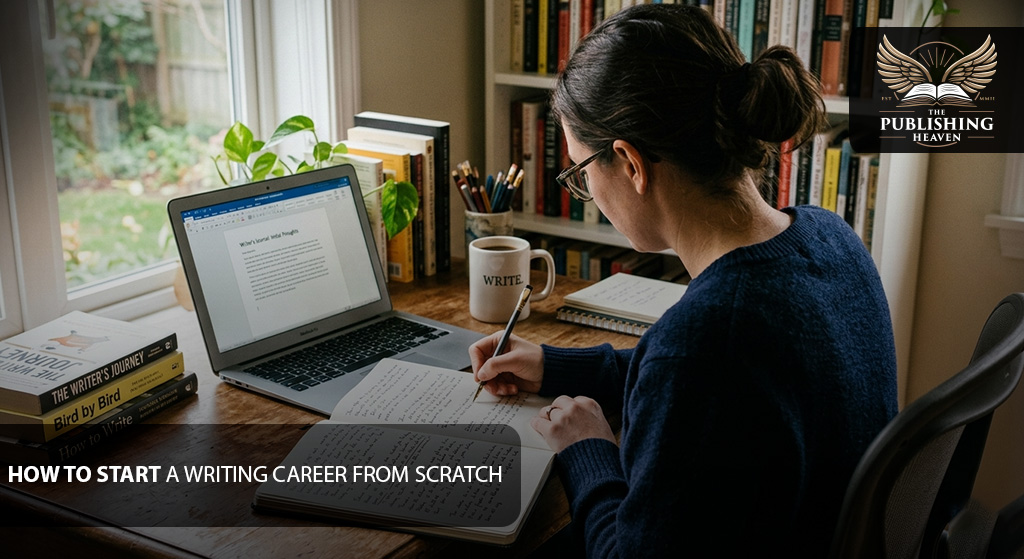
The Dream That Feels Impossible
You dream of becoming a writer. Not just someone who writes for fun, but a real author – with books, readers, and maybe even an income. But you have no experience. No credentials. No network. No idea where to begin.
You look at successful authors and think: they must have known someone, or studied writing in college, or gotten lucky. You wonder if someone like you can ever break in.
Here is the truth: every professional writer started exactly where you are – with nothing but a desire to write and the willingness to learn. No one is born a published author. Writing careers are built, not given.
This guide gives you a practical, step‑by‑step roadmap to start a writing career from scratch. You will learn how to develop your skills, find your niche, build a portfolio, get your first paid work, and grow into a sustainable career. No shortcuts. No magic. Just actionable steps that have worked for thousands of writers before you.
Let’s turn your dream into a profession.
What a “Writing Career” Actually Means in 2026
Twenty years ago, a writing career meant getting a staff job at a newspaper or landing a book deal with a traditional publisher. Today, the landscape is completely different.
Ways to earn as a writer in 2026:
- Self‑published author: Publish your own books on Amazon KDP and keep 70% of royalties.
- Freelance writer: Write articles, blog posts, or copy for businesses and websites.
- Ghostwriter: Write books or content for clients who take the credit (pays well).
- Content creator: Build an audience on social media or Substack and monetize through subscriptions.
- Technical writer: Create documentation, manuals, or help content for companies.
The good news: You do not need a degree or previous experience. You need samples, persistence, and a system. This guide focuses on becoming a self‑published author, but the foundational steps apply to any writing path.
Key statistic for 2026: The number of self‑published authors earning a full‑time living has grown 300% in the last five years. The door is wider open than ever.
The Publishing Heaven insight: We have watched hundreds of writers go from zero to published author. The ones who succeed are not the most talented. They are the ones who follow a system, produce consistent work, and treat writing as a profession – not a hobby.
12 Steps to Start a Writing Career from Scratch
Step 1: Write Every Day (Build the Habit)
You cannot have a writing career without writing. The first and most important step is to build a daily writing habit.
How to start:
- Set a tiny goal: 100 words per day. That is one paragraph.
- Write at the same time every day (morning is best for most people).
- Do not edit. Do not judge. Just produce.
Why this works: Small daily actions compound. In one year, 100 words per day becomes 36,000 words – half a book. More importantly, you train your brain to write on demand, not just when inspiration strikes.
Actionable step: Commit to 30 days of daily writing. Use a habit tracker. Do not miss a single day.
Step 2: Read Like a Writer
Writers read differently than casual readers. You need to study what works and why.
How to read like a writer:
- Notice sentence structure, pacing, and word choice.
- Mark passages that move you. Ask: why does this work?
- Study the first pages of bestselling books. How do they hook you?
- Read books in the genre you want to write. Understand reader expectations.
Actionable step: Read one book per week in your target genre. Keep a notebook. Write down three things you learn from each book.
Step 3: Find Your Niche (Don’t Write for Everyone)
Beginning writers often try to write “anything.” That makes it hard to build expertise and find clients. Choose a niche.
Popular writing niches for beginners:
- Romance novels
- Mystery/thrillers
- Self‑help / personal development
- Business / leadership
- Memoir
- Children’s books
How to choose:
- What do you enjoy reading?
- What do you know more about than most people?
- Is there a market for this niche? (Search Amazon.)
Actionable step: Choose one niche. Write three sample pieces in that niche. Do not switch niches until you have published something.
Step 4: Build a Portfolio (Samples, Not Credentials)
You do not need a degree. You need proof that you can write. A portfolio of 3-5 strong samples is your ticket.
What to include in your portfolio:
- Two sample chapters of a book (can be unpublished)
- One blog post or article in your niche
- One short story or personal essay
- (Optional) Any published work, even if self‑published
Where to host your portfolio:
- Free: Medium, Substack, or a free WordPress site
- Paid: Your own domain (cost: $10-$15/year)
Actionable step: Write two sample chapters this month. Publish them on Medium or your own site.
Step 5: Learn the Business Side (Yes, It Matters)
Writing is an art. A writing career is a business. You need basic business skills.
What to learn:
- How to write a book description that sells
- How to choose keywords and categories on Amazon
- How to format a book for Kindle and paperback
- How to set up a free email list
- How to pitch clients (if freelancing)
Actionable step: Spend one hour per week studying the business of writing. Read blogs, watch free YouTube tutorials, or take a low‑cost course.
Step 6: Publish Your First Book (It Does Not Have to Be Perfect)
Many aspiring writers wait for the perfect manuscript. They never publish. Break the cycle.
Your first book does not need to be a bestseller. It just needs to exist. Publishing your first book teaches you the process, builds confidence, and gives you credibility.
How to publish your first book on a budget:
- Write a short book: 10,000‑20,000 words (a novella or short guide).
- Use a pre‑made cover ($150-$400) or a simple custom cover ($500).
- Run a free proofreading pass (or use a low‑cost editor).
- Publish on Amazon KDP (free).
Actionable step: Set a 90‑day goal to publish your first book. Keep the scope small. Do not aim for a 300‑page epic.
Step 7: Get Feedback and Improve
You cannot improve in isolation. You need outside eyes.
Where to get feedback for free:
- Writing groups (online or local)
- Beta reader exchanges (you read their work, they read yours)
- Online critique communities (Scribophile, Critique Circle)
What to ask for: Honest feedback, not praise. Ask: where did you get bored? What confused you? Would you recommend this to a friend?
Actionable step: Join one writing group this week. Share a sample chapter. Accept feedback without getting defensive.
Step 8: Start Building an Audience (Email List First)
Your audience is your career insurance. Social media algorithms change. Your email list is yours forever.
How to start your email list for free:
- Use MailerLite (free up to 1,000 subscribers).
- Add a signup link inside your book: “Join my newsletter for a free bonus chapter.”
- Create a lead magnet (a free short story, checklist, or resource).
- Share your signup link on social media and in your author bio.
Why start now: Even if you have no readers, building a list takes time. Start on day one.
Actionable step: Set up a free email account and signup form today. Aim to get 10 subscribers this month.
Step 9: Apply for Paid Writing Gigs (If You Want Income While You Write)
Writing a book takes time. If you need income, freelance writing can pay the bills while you build your author career.
Where to find paid writing gigs for beginners:
- Upwork (create a profile, bid on small jobs)
- ProBlogger job board
- Contena (aggregates writing jobs)
- Cold pitch websites in your niche (e.g., email a blog owner: “I can write a post about X”)
What to charge as a beginner: $0.05-$0.10 per word ($25‑$50 for a 500‑word article). Raise your rates after 3‑5 gigs.
Actionable step: Create a profile on one freelance platform this week. Send 5 pitches.
Step 10: Treat It Like a Career (Consistency Over Intensity)
A writing career is not a sprint. It is a marathon. The authors who succeed are not the ones who wrote a brilliant book in a burst of inspiration. They are the ones who kept showing up.
What consistency looks like:
- Write 250‑500 words every day.
- Publish one piece of work (book, article, or chapter) every 2‑3 months.
- Grow your email list by 10‑20 subscribers per week.
- Learn one new skill every month.
Actionable step: Set a weekly writing goal (e.g., 2,500 words). Track it. Do not break the chain.
Step 11: Network with Other Writers (No, You Do Not Need to Be Extroverted)
Writing is solitary. But a career requires community. Other writers provide support, feedback, job leads, and accountability.
How to network as an introvert:
- Join online writing groups (Facebook, Reddit, Discord).
- Comment thoughtfully on other writers’ work.
- Participate in writing challenges (NaNoWriMo, etc.).
- Attend virtual writing conferences (many are free or low‑cost).
Actionable step: Join one online writing community today. Introduce yourself. Reply to one post.
Step 12: Never Stop Learning (The Learning Curve Never Ends)
The best writers are always learning. Publishing platforms change. Reader tastes shift. New marketing tools emerge. Stay curious.
Where to learn for free or cheap:
- YouTube (author vlogs, writing craft videos)
- Podcasts (“The Creative Penn,” “Self‑Publishing Show”)
- Free courses from Reedsy or KDP University
- Writing craft books from your library
Actionable step: Identify one skill you lack (e.g., understanding Amazon ads). Spend 30 minutes learning it this week.
5 Mistakes Beginners Make (And How to Avoid Them)
Mistake 1: Waiting for Permission
You think you need a degree, a certificate, or someone to tell you that you are ready. You do not.
Fix: Start now. Your first work does not have to be perfect.
Mistake 2: Editing as You Write
You polish every sentence. You never finish.
Fix: Write the first draft as fast as possible. Editing comes later.
Mistake 3: Writing for Free (For Exposure)
Exposure does not pay rent. Some free work is fine for samples, but do not make a habit of it.
Fix: Charge for your work, even a small amount, as soon as you have samples.
Mistake 4: Ignoring the Business Side
You think writing is all that matters. Then you publish and get no sales.
Fix: Spend 20% of your time learning marketing, keywords, and platform rules.
Mistake 5: Giving Up After the First Rejection
Every writer gets rejected. Bestsellers were rejected dozens of times.
Fix: Expect rejection. Learn from it. Keep producing.
Mistake 6: Comparing Yourself to Established Authors
You look at authors with 20 books and a huge following. You feel inadequate.
Fix: Compare yourself only to where you were yesterday. Every author started with zero.
Comparison Table: Writing Career Paths at a Glance
| Path | Time to First Income | Income Potential | Best For |
| Self‑published author | 6‑12 months | Low to high (scalable) | Creatives who want ownership |
| Freelance writer | 1‑3 months | Low to medium | Writers who need quick income |
| Ghostwriter | 3‑6 months | Medium to high | Writers who prefer anonymity |
| Content creator (email) | 3‑12 months | Medium (subscriptions) | Writers who enjoy audiences |
| Technical writer | 2‑4 months | Medium to high | Writers with a technical bent |
Examples / Use Cases: Real Writers Who Started from Scratch
Use Case 1: The Stay‑at‑Home Parent Who Self‑Published a Short Book
Before: Maria had no writing experience. She was a stay‑at‑home mom with a passion for organization.
What she did: She wrote a 15,000‑word guide on decluttering your home. She bought a pre‑made cover ($250), ran a free proofreading pass, and published on KDP.
After: The book made $300 in its first month. It was not a full‑time income, but it proved she could do it. She wrote two more guides and now earns $2,000 per month. Maria says, “I started with nothing but a laptop. My first book was short and imperfect. It changed my life.”
Use Case 2: The Freelancer Who Built a Portfolio with Zero Experience
Before: Tom wanted to write but had no credentials. He created a free Medium account and published one article per week for three months.
What he did: He wrote about productivity (his niche). After 12 articles, he had a portfolio. He pitched a business blog owner.
After: He landed a $200 per article gig. Within a year, he was earning $3,000 per month freelancing. Tom says, “Samples are your degree. I never needed a certificate.”
Use Case 3: The Ghostwriter Who Learned by Doing
Before: Lisa wanted to write books but hated the idea of promoting herself. She discovered ghostwriting.
What she did: She wrote two sample chapters in the self‑help niche. She pitched coaches and consultants who needed books.
After: She landed a $5,000 ghost writing project. Her client published the book and sold 1,000 copies. Lisa now earns $60,000 per year ghostwriting. She says, “I never have to market my own name. I just write.”
Use Case 4: The Author Who Published a Series from Scratch
Before: David had no audience and no experience. He decided to write a cozy mystery series.
What he did: He wrote book one (50,000 words) in six months, using a pre‑made cover and low‑cost editing. He published on KDP and enrolled in Kindle Unlimited.
After: Book one sold 200 copies in its first year. Book two sold 500. Book three sold 1,200. His combined backlist now earns $1,500 per month. David says, “The first book was the hardest. Every book after gets easier.”
Use Case 5: The Career Changer Who Took a Course
Before: James worked in retail. He had no writing experience. He wanted a complete career change.
What he did: He took a free online course in copywriting. He built a portfolio of 5 practice pieces. He applied for junior freelance gigs.
After: Within 9 months, he was earning $2,500 per month writing email copy for small businesses. He quit his retail job. James says, “I had zero credentials. My portfolio was my resume.”
Conclusion: Your Writing Career Starts Today
Starting a writing career from scratch is not about talent. It is about following a system, showing up consistently, and publishing your work – even when it is not perfect.
Your 90‑day action plan to start your writing career:
- Month 1: Write 250 words daily. Read two books in your niche. Create a portfolio (2 sample chapters). Set up an email list.
- Month 2: Write and publish your first short book (10,000‑20,000 words). Join a writing group for feedback. Start pitching freelance gigs (if desired).
- Month 3: Publish a second short book or write book two of a series. Grow your email list to 50 subscribers. Review your progress and set new goals.
You do not need credentials, connections, or luck. You need a roadmap and the courage to start. Every professional writer you admire began exactly where you are now.
Your writing career is waiting. Take the first step today.
FAQs: Starting a Writing Career from Scratch
Q: Do I need a degree in English or journalism to become a writer?
No. Most successful writers do not have formal writing degrees. Your portfolio matters far more than your diploma.
Q: How much money can I make as a beginner writer?
Freelance beginners often earn $25-$100 per article. Self‑published authors often make $100-$1,000 in their first year. With consistent effort, you can grow significantly.
Q: What if I write something and no one reads it?
That is normal. Your first few pieces may have few readers. Keep publishing. Keep learning. Every successful author started with zero readers.
Q: Should I write for free to get samples?
A few unpaid pieces to build a portfolio are fine. Do not make it a habit. Once you have 3‑5 samples, start charging.
Q: How many books do I need to write before I see real income?
Most self‑published authors start seeing steady income after 3‑5 books. The backlist is where the money grows.
Q: Can I start a writing career while working full‑time?
Yes. Most writers do. Write early in the morning or on weekends. Consistency matters more than hours.
Q: Does The Publishing Heaven help new writers start their careers?
Yes. The Publishing Heaven offers ghostwriting services, professional editing, cover design, formatting, and publishing guidance. Whether you need help writing your first book or polishing it to professional quality, we support beginners at every stage. Contact us for a free consultation.
Strong Call-to-Action (CTA)
You now have a step‑by‑step roadmap to start your writing career from scratch. But knowing the steps is not enough. You need to take action – and sometimes you need a partner to help you cross the finish line.
At The Publishing Heaven, we help new writers publish their first books. Our professional editing, custom cover design, formatting, and publishing guidance turn your rough draft into a professional product. You focus on writing. We handle the rest.
We are a premium, one‑stop publishing solutions company. Do not let fear or inexperience hold you back. Let us help you launch your writing career.
Ready to start your writing career today?
Visit The Publishing Heaven to schedule your free consultation. Let’s turn your dream into a profession – one word at a time.
